Top 31 Photo Viewers for Windows in 2026
Updated: October 17, 2025 Author: Anna Kondaurova, Vitaly
The article discusses 31 of the most functional and convenient photo viewers for PC today. All programs are divided into several categories, including utilities, managers and programs for cataloging photos, as well as photo editors. The advantages and disadvantages of each photo viewer have been identified to help users find the program that perfectly suits their goals.
Rating leader - a modern application for viewing and cataloging photos with face recognition
A good set of tools that will help you sort, adjust and convert photos
A photo viewer is a fairly broad concept. Indeed, under this term, you can “fit” both simple utilities and powerful photo editors. In fact, both of them will cope with the main task, which is viewing the image. But how do they do it? What tools do they have? Does the user need to search for the right button for half an hour, or will he/she be able to examine the desired frame in detail just by one click? Let's figure it out.

TOP evaluation criteria
Since the top considers completely different programs in terms of their functionality, the applications will be divided into several types:
- Photo viewers and cataloging programs. They'll open and help you sort photos in your personal and professional photo archive.
- Photo editors. They can not only open images but also help you edit and convert them.
- Cloud services. Programs that connect to network file storage.
- Simple utilities. They offer a minimal set of functions: open an image, start a slideshow, and view photo metadata.
Photo viewers can be completely different. But one thing that unites them is the search for a solution to the problem of opening and viewing images. Therefore, they were also compared with each other in a sort of ranking. The following characteristics served as the evaluation criteria:
- Usability. Friendliness and ease of use.
- Cross-platform. This means the ability to use a software solution on different platforms, on several devices at once.
- Accessibility. This refers to how easy the app is to install and use. For example, how complicated is the program download/installation algorithm, is the price affordable or not, and other restrictions.
- Multi-format. This means either a program can work with different image formats or not.
- Speed. This includes program opening speed and responsiveness when navigating through large directories.
- Overall impression. A subjective assessment that allows you to recommend this or that application as a photo viewer.
Photo viewers and organization software
Tonfotos
The leader of the rating, which in all respects took 9-10 points.
Convenient, intuitive interface with a good set of tools for comfortable file organization, which can display photos both on the computer's hard drive and on removable media in cloud storage at the same time. There are functions search for duplicate photos, as well as face recognition in photos.
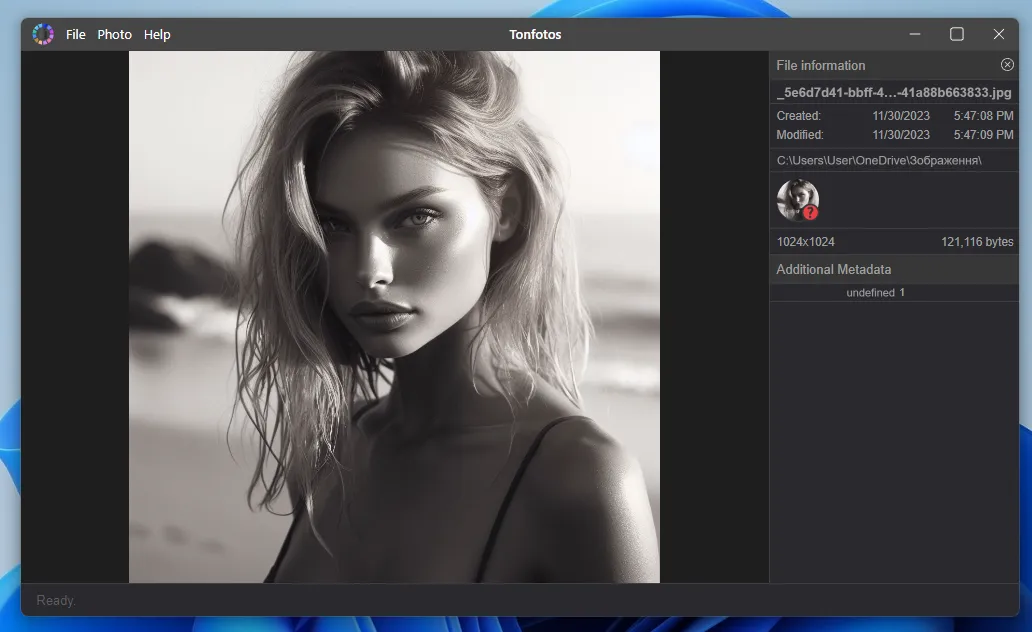
The program is available both for free use (with slightly reduced features) and for purchase. Moreover, the free version is quite suitable for use on a home PC, but if you need more significant features, then you can simply pay for a license.
Advantages of the program:
- Lightweight, not overloaded intuitive design. There are light and dark themes.
- Import files from mobile devices.
- Photos of friends from the app are available in the program.
- Good face recognition in photos.
- Quick search by filming location, date and more.
Disadvantages of the program:
- With a large amount of photos, a long initial indexing is possible.
- There are no photo editing tools. Initially, the program is not intended for these purposes. It is aimed at organizing and working with an archive of images, but not correcting a photo.
Picasa
One of the most popular "old school" programs Picasa is still in demand and relevant, despite the fact that it has not been updated for more than 10 years. In this article we looked at modern alternatives for Picasa.
A free, but at the same time “thought-out” program, for its time, had excellent innovative functionality, which are convenient systematization of files located in different directories, a face recognition function and other tools.
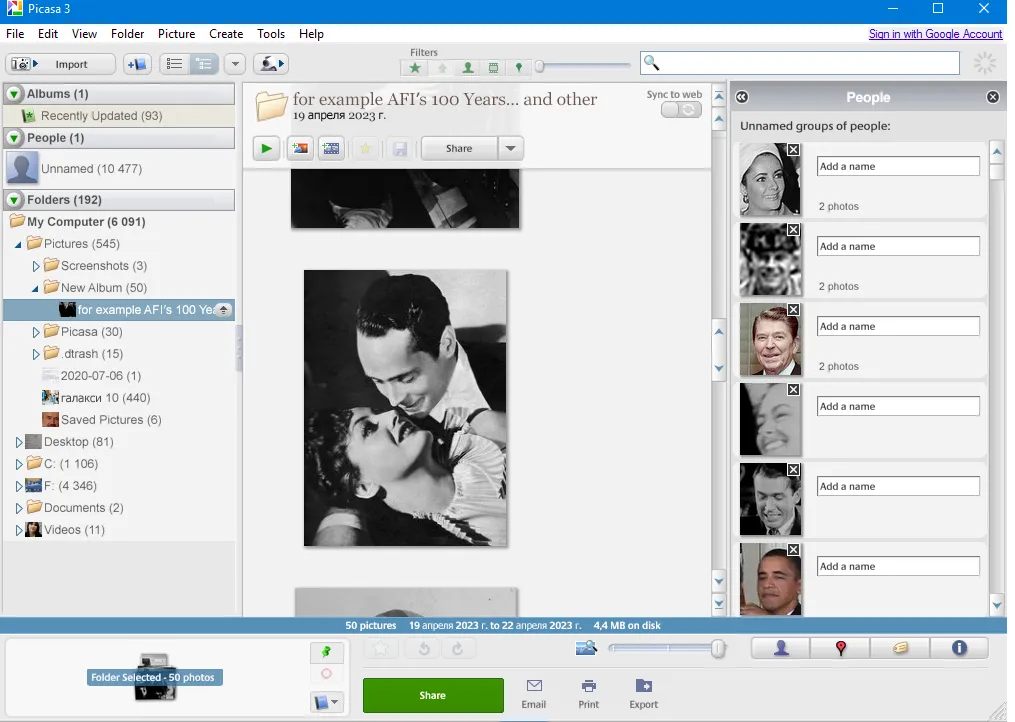
Now only old versions of the program are available for download, which work great on modern operating systems. But the search for installation files may take some time. And it’s not enough to find the file itself, you also need to check the security of the resource from which this file will be downloaded to make sure that you don’t install anything unexpected on your computer or device.
Advantages of the program:
- Intuitive interface.
- An excellent combination, for its time, free and innovative functionality.
- Face recognition.
- Binding to a Google account and the ability to work with it.
- Ability to create slide shows.
Disadvantages of the program:
- Work algorithms are already obsolete. The program may not meet the requirements of modern programs for the quality of "reading" files, their systematization for face recognition.
- It requires downloading installation files from dubious sites.
- It does not support modern image formats webp and HEIC.
- There are freezes in work.
Ashampoo Photo Commander FREE
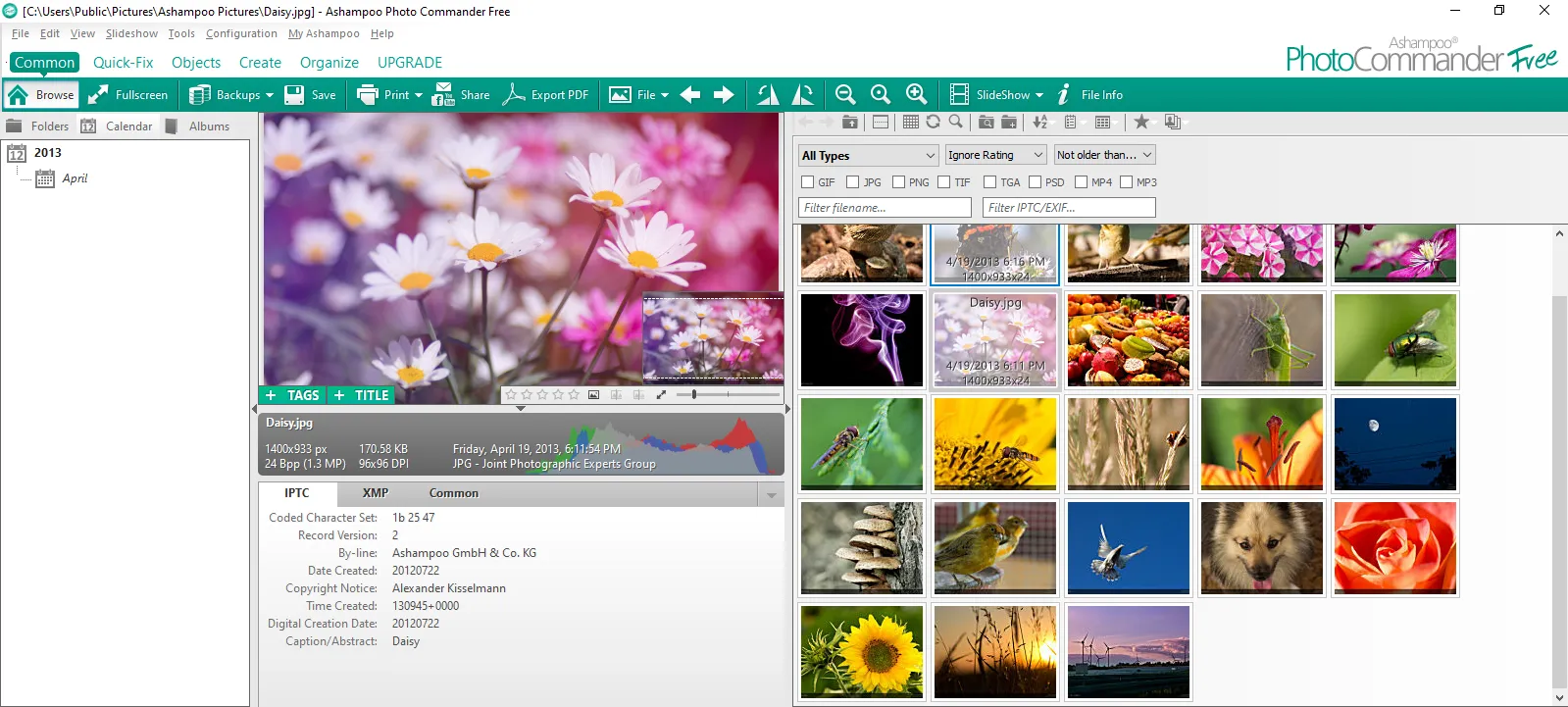
Despite the fact that the program is completely free, Ashampoo Photo Commander FREE has everything you need to catalog photo archives of any size. The application supports reading, editing and subsequent sorting of photos by metadata. Particularly useful is the ability to tag and create a title, the presence of which subsequently simplifies the search for the desired photo. Just enter a key request in the search, and the desired photo will be displayed on the screen. Creating albums will allow you to catalog a photo archive without having to manually move files in the computer's memory.
In addition, Ashampoo Photo Commander FREE has basic editing functions. Without using third-party programs, you can remove scratches, adjust color, brightness, and perform simple retouching.
The program interface is well thought out and structured. Therefore, despite the extensive range of features, even a user who has not previously worked with similar applications will be able to quickly understand the settings of Ashampoo Photo Commander FREE.
Advantages programs
- The program is completely free and has no restrictions on functionality.
- A well-designed interface that is easy to understand even for a beginner.
- It is possible to search photos by metadata.
- Availability of basic image editing functions.
Disadvantages of the program
- Despite its convenience, the program's interface looks a little outdated compared to modern analogues.
- Ashampoo Photo Commander FREE has a low level of automation; most settings must be done manually. There is no function for recognizing and identifying people's faces.
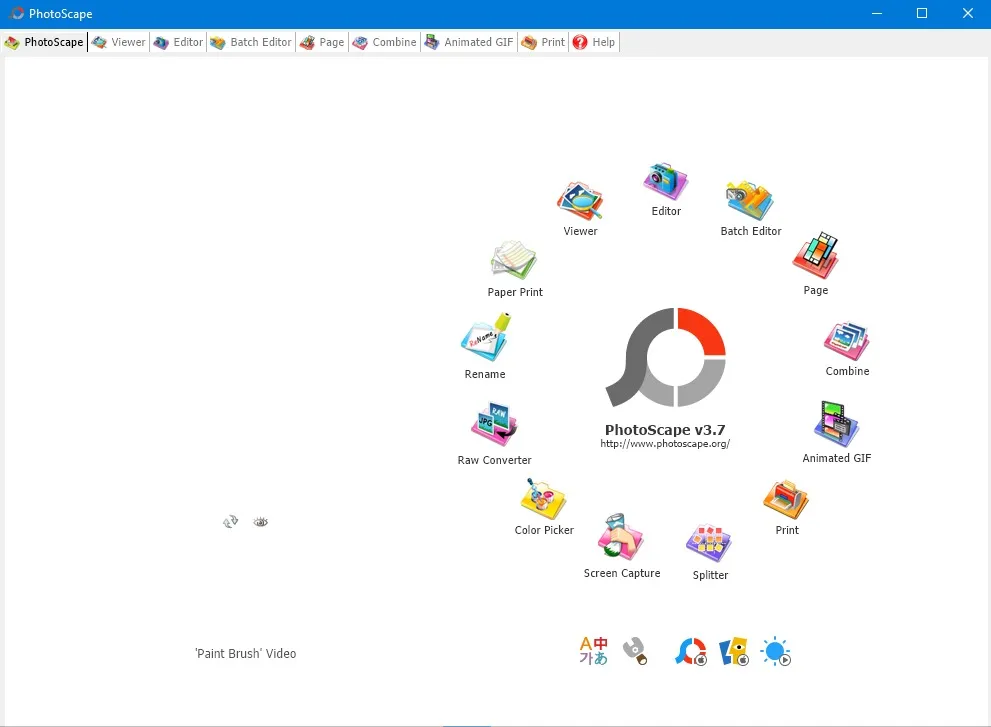
PhotoScape X
PhotoScape was originally designed to run on macOS. Therefore, it has such an “unusual” design (especially for those who have not worked in programs alternative to “window” systems). But over time, PhotoScape began to work fine on Windows as well.
In addition to viewing photos, there is a decent set of tools here:
- small photo editor;
- batch processing;
- creating collages;
- screen capture;
- and other useful features.
Numerous versions of the program have been translated into more than 20 languages. The application is available for download on the official website.
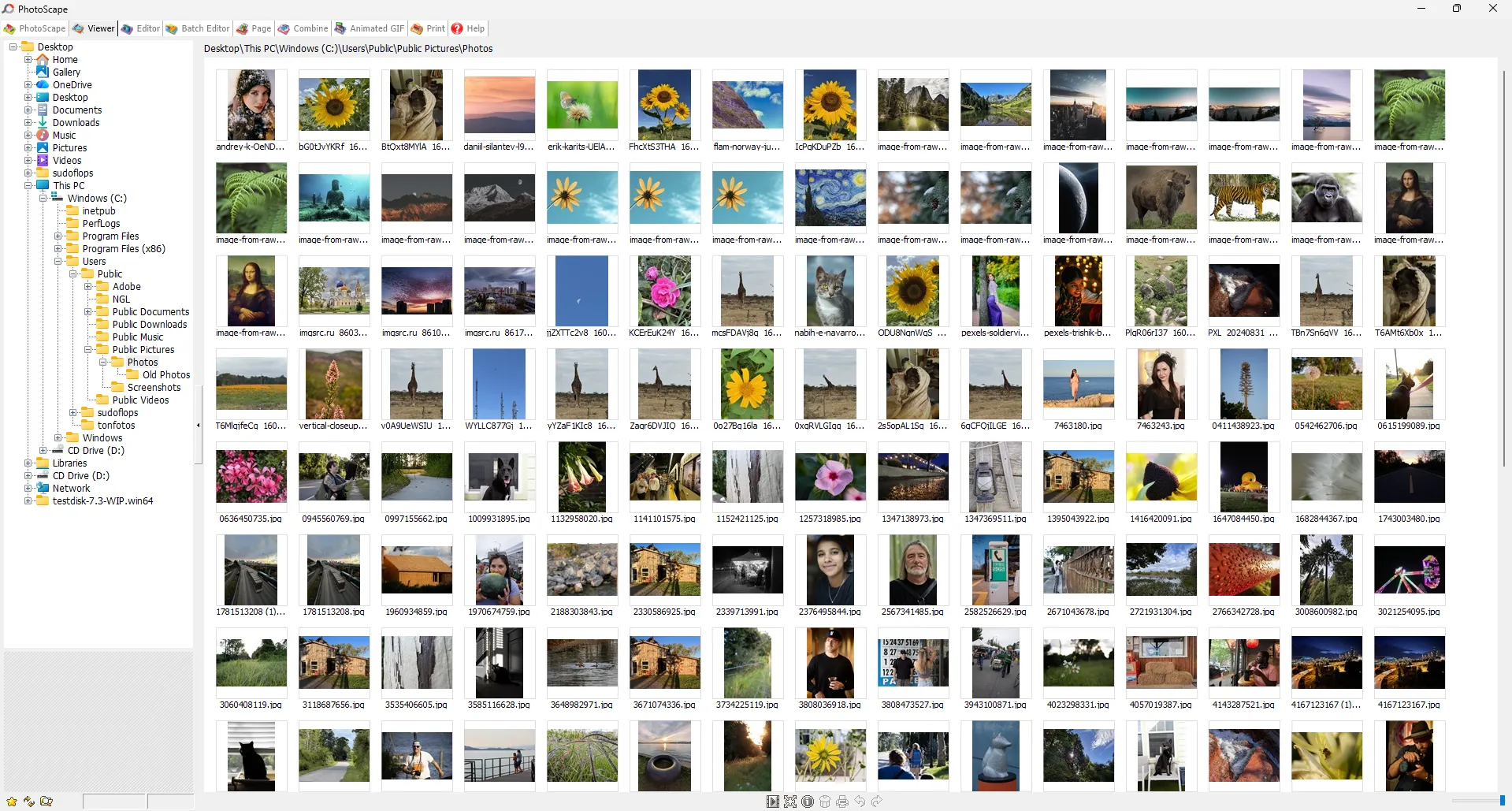
Despite the program is quite popular and has been translated into more than 20 languages, it does not apply to all versions. There are two versions of the application: for home use (X) and professional (Pro). The latter costs about $39.99.
Advantages of the program:
- You quickly get used to the specific interface. It is built logically and intuitively.
- Good photo editor. Changes to the image can be undone with a couple of mouse clicks.
- You can make various collages and animations.
- The program works with equal files. There is a converter for those who need to convert a complex file into an easier one.
Disadvantages of the program:
- No functions for face recognition, search by shooting location
- No batch conversion.
- Trimmed functionality of the free version.
DigiKam
Another program that was not originally written for "window systems" is DigiKam. Its "roots" can also be traced in its interface. The operating system for which the program was written was originally Linux. Today the program is also adapted for Windows and MacOS.
The program has extensive functionality, which, unfortunately, is hidden under the specific design and logic of building a solution to problems in the app.
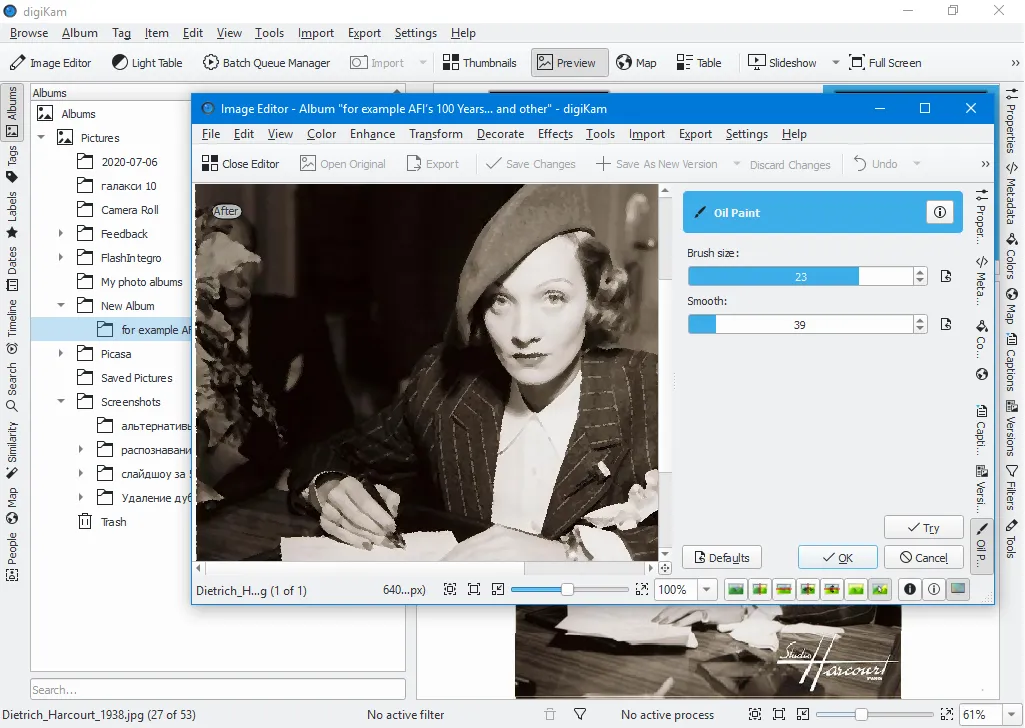
With the help of the program, you can sort photos by tags, name, date or geolocation. There is a small photo editor. And the function of face recognition is a little "crooked".
Open source donation program. You can download it from the corresponding website.
Advantages of the program:
- Customizable automatic import from third party devices and USB drives.
- There are tools for systematizing the archive, such as face recognition, geolocation binding.
- Ability to publish photos in a variety of services.
Disadvantages of the program:
- It creates duplicate photos when creating albums.
- Specific interface.
- Low quality face recognition.
- There are freezes in work.
Photo ExpressViewer
A program from the Japanese company Ichikawa Soft Laboratory (creators of SILKYPIX), it is positioned as a high-speed tool for selecting and pre-sorting huge amounts of RAW data. Unlike heavy cataloging programs, Photo ExpressViewer relies on instant rendering by utilizing the graphics card (GPU) and reading built-in previews.
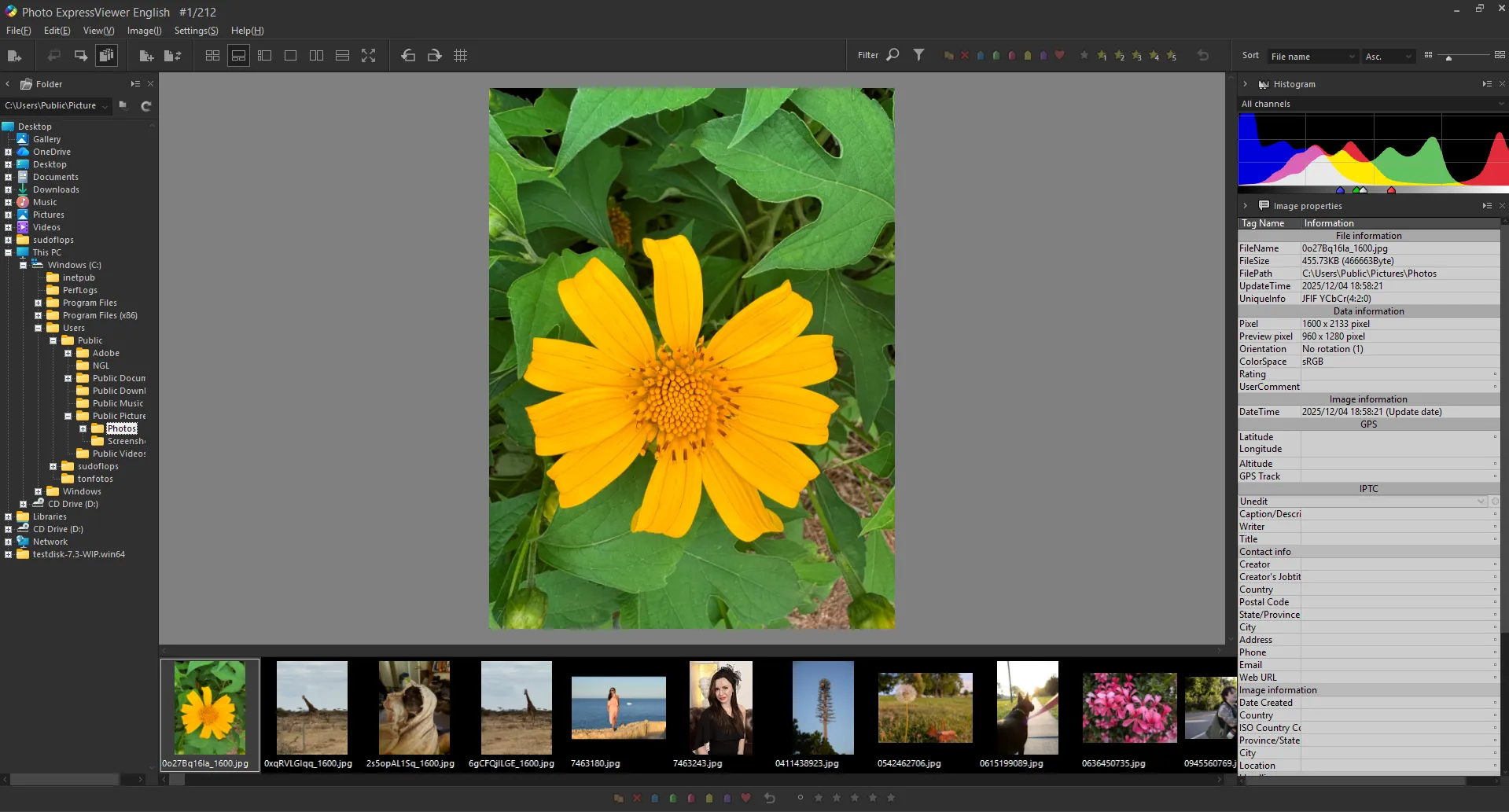
The app is ideal for the culling stage, when you need to quickly review thousands of shots after shooting, rank them, and select the best ones for subsequent development. The program supports importing from external media, batch renaming, and advanced EXIF data searching.
Advantages of the program:
- Performance. Using a GPU allows for smooth scrolling and instant zooming of large RAW files without rendering delays.
- Flexible labeling system. In addition to the standard star rating, custom color labels are available, which can be combined (up to 32 combinations).
- Professional comparison tools. Multi-preview mode lets you compare multiple frames vertically or horizontally to select the sharpest take.
- Working with metadata. Deep search and filtering by shooting parameters (focal length, aperture, ISO) and keywords.
- Affordable price. Unlike competitors with subscription models, the program is offered for a reasonable one-time fee (around 3,000 yen or ~$20).
Disadvantages of the program:
- Lack of editing features. This is a pure viewer and manager. Therefore, for color correction, you'll have to send files to an external editor.
- The interface is unique. The design follows the "Japanese school" with an abundance of small icons, which can take some getting used to after using Adobe products.
- Platform limitations. The program is optimized primarily for Windows.
IrfanView
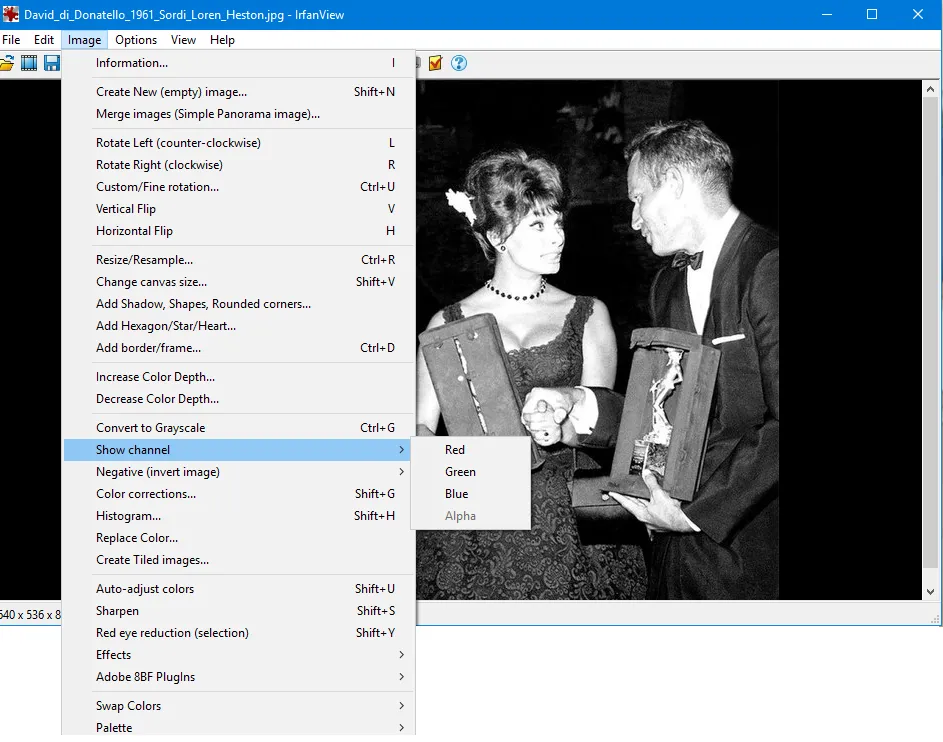
A true veteran that remains relevant thanks to its lightweight design and plugin support, IrfanView. weighs just a few megabytes, but with the full extension package installed, it becomes a powerful tool capable of opening video and rare engineering formats.
For archive management, IrfanView has a separate companion application, IrfanView Thumbnails. It opens as a second window and allows you to browse the folder tree, move files, and run batch processing.
The program is completely free for home use. Its design is extremely minimalist, but this ensures lightning-fast startup even on "ancient" hardware.
Advantages of the program:
- Minimal weight. Consumes virtually no system resources.
- Powerful batch processing. One of the best algorithms for mass renaming or resizing photos.
- Plugin support. You can add features not included in the base, from effects to support for new formats.
- Free. Full functionality is available with no hidden fees.
Disadvantages of the program:
- Splitting into two windows. Not everyone finds it convenient to switch between the preview window and the thumbnail window.
- Menu-oriented. Most functions are hidden in text menus rather than in clear icons.
- Poor cataloging. No tagging or facial recognition system; all management is tied to a standard file structure.
FastStone
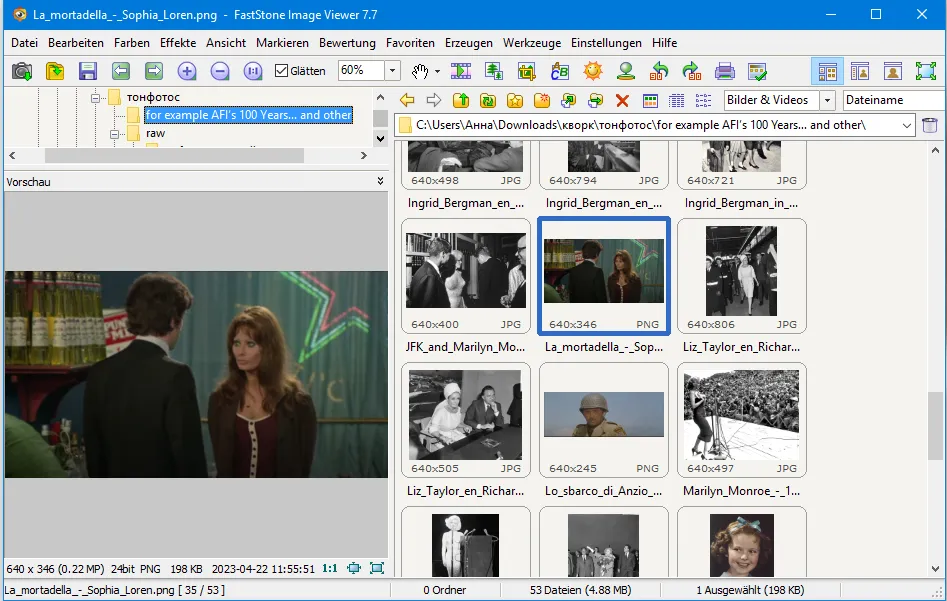
FastStone is the "golden mean" between simple utilities and heavy-duty managers. The program maintains high speed even when browsing folders with thousands of files and offers sophisticated tools for initial sorting and selection.
The program's unique feature is its functional full-screen mode. When a photo is maximized, hovering the cursor over any edge reveals panels with tools, EXIF data, and a thumbnail feed. This allows you to examine your photos in detail without being distracted by the interface.
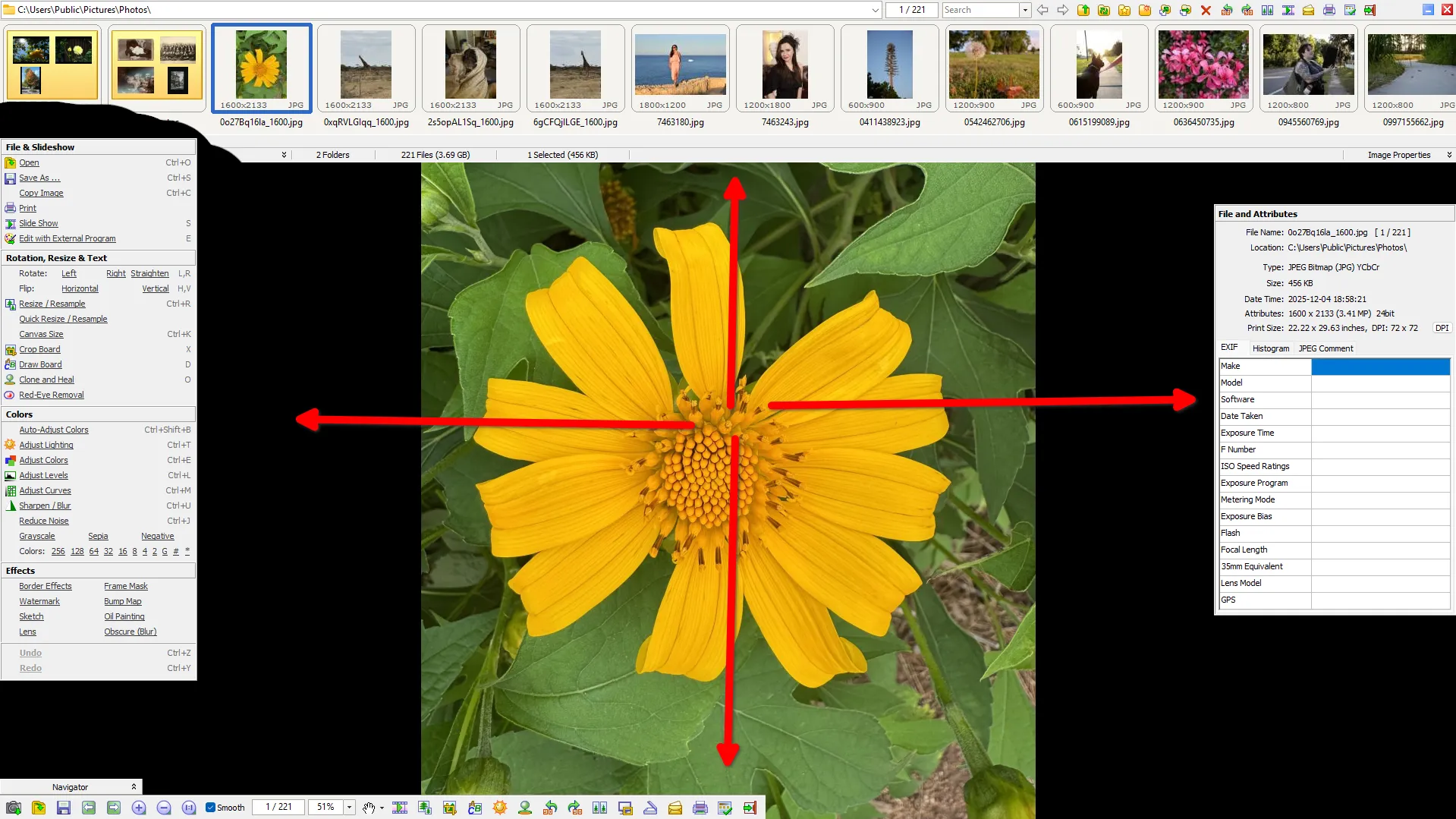
A convenient file tagging mechanism and rating system are available for cataloging. The program also features a powerful image comparison tool. You can display up to four photos side by side and zoom them simultaneously to select the sharpest frame.
Advantages of the program:
- Speed. Instant preview generation and quick navigation through RAW files.
- Comparison mode. Ideal for filtering out similar images.
- Portability. There's an official version that doesn't require installation and can be carried on a flash drive with the entire archive.
- Unique interface. Pop-up panels in full-screen mode save workspace.
Disadvantages of the program:
- Outdated design. The main window's appearance is reminiscent of the Windows XP era.
- Windows only. macOS and Linux users are left out.
XnView
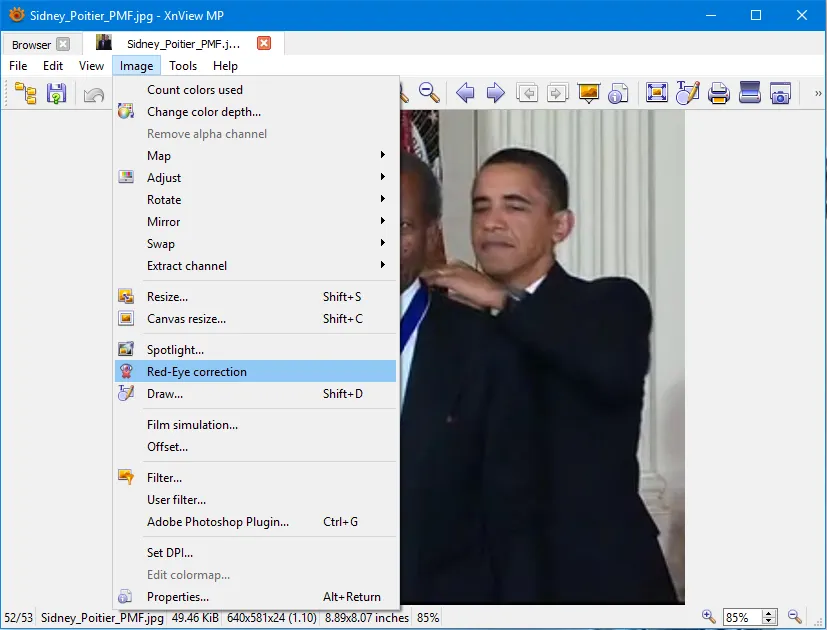
This is the cross-platform successor to the classic XnView. The "MP" (Multi-Platform) prefix means the program runs equally well on Windows, macOS, and Linux. It's one of the most omnivorous solutions: it supports over 500 graphic formats.
In terms of cataloging, XnView MP supports categories, keywords, and advanced metadata searching (IPTC, XMP). The MP version even includes rudimentary facial recognition features, a rarity among free viewers.
The program is free for non-commercial use. For organizations, a license costs approximately 29 euros, which is well worth the functionality.
Advantages of the program:
- Cross-platform. Ideal if you work on multiple operating systems.
- Advanced metadata management. Allows you to professionally describe photos for photo stocks or archives.
- Duplicate Finder. This built-in feature helps you quickly clean up your drive of unnecessary copies.
- A huge number of settings. You can customize the interface for any task.
Disadvantages of the program:
- Difficult for beginners. The interface is overloaded with buttons and tabs, making it easy to get lost.
- Heaviness. Due to its abundance of features, the program may run slightly slower than more streamlined utilities like JPEGView.
Photo Mechanic
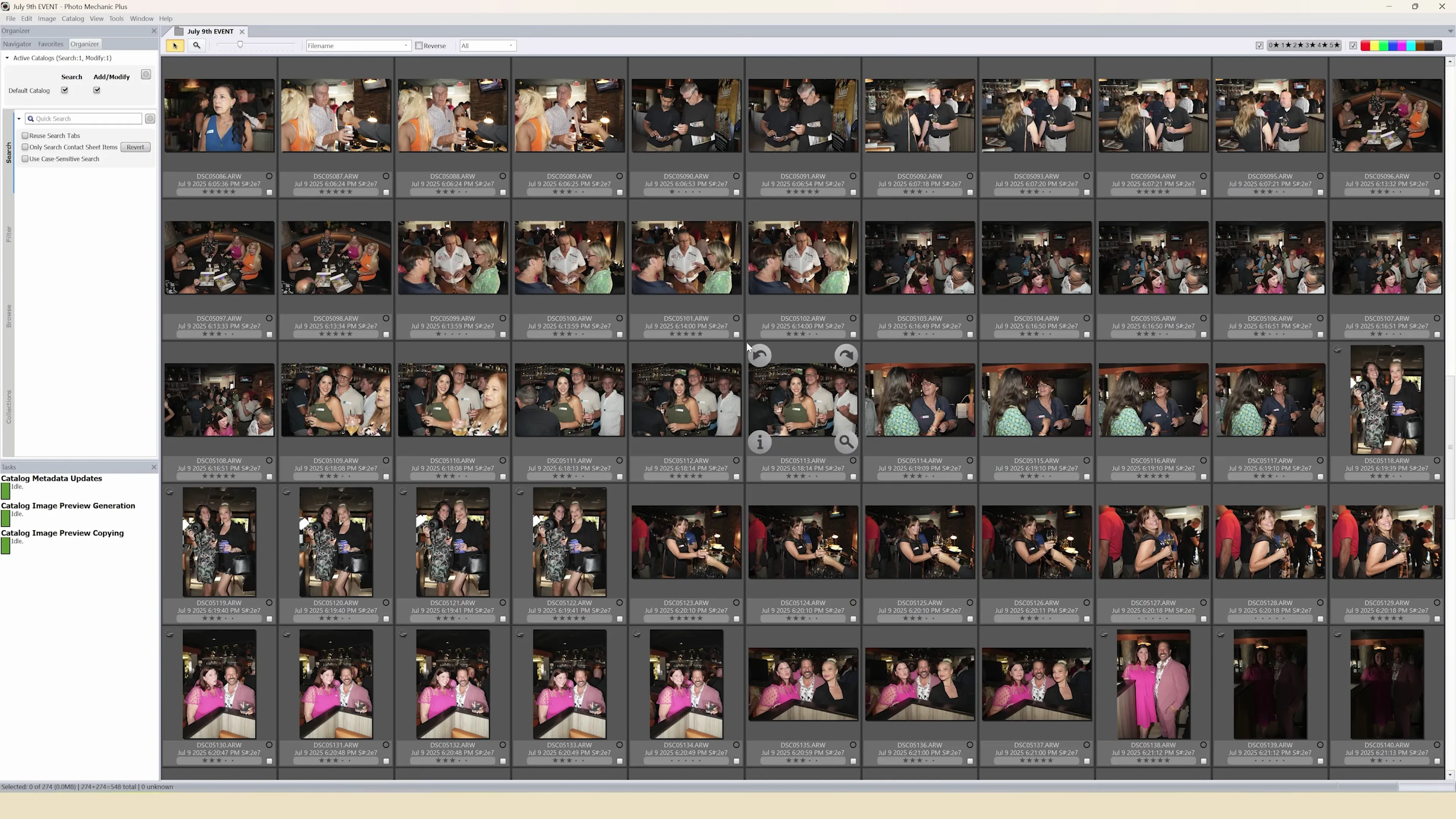
Photo Mechanic is more than just a photo viewer; it's a specialized, high-speed media browser. Designed for professionals working with large volumes of images and requiring instant organization and delivery (photojournalism, sports, and wedding photography). Photo Mechanic's key differentiator isn't editing, but rather its unrivaled selection speed, achieved by instantly displaying JPEG previews embedded in RAW files. This saves photographers hours on initial sorting.
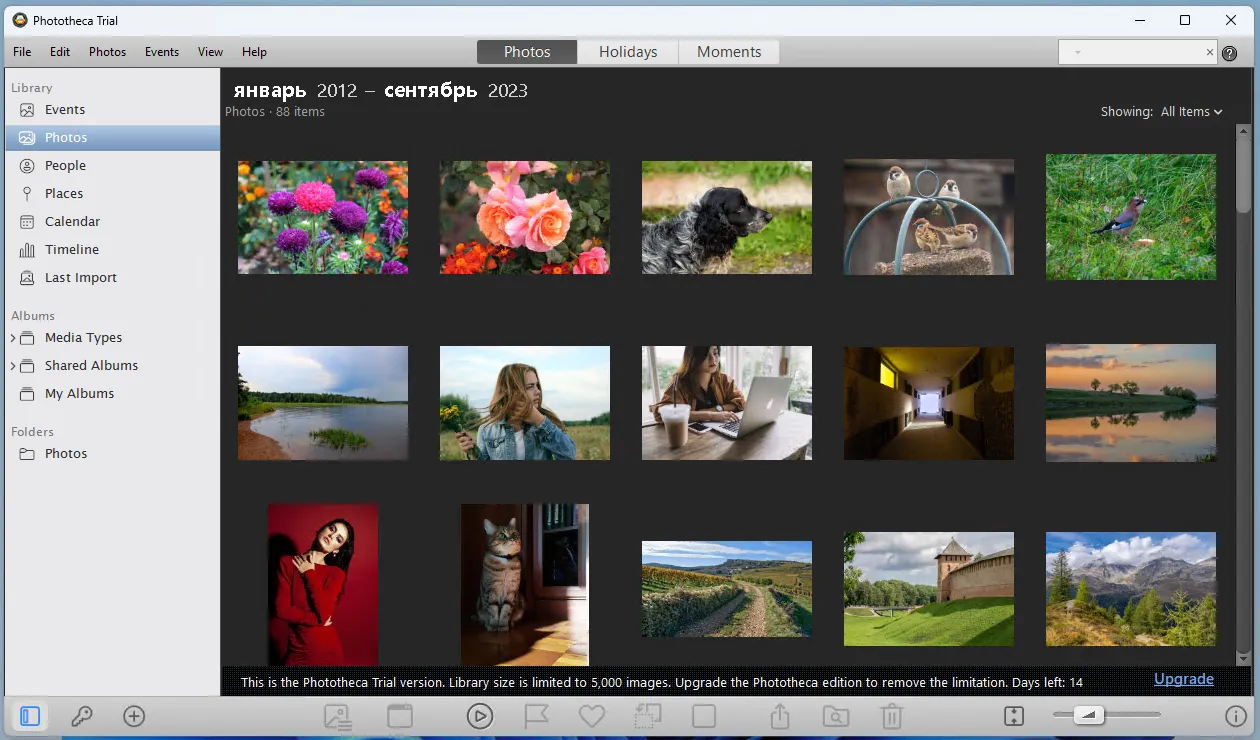
In addition, the application provides various tools for bulk input of structured information. Despite the relatively high cost of the license (around $300), it is lifetime and therefore more cost-effective than subscriptions.
Benefits of the program
- RAW file viewing speed. Instant switching between frames is critical when working with thousands of images.
- Powerful tools for bulk metadata entry. Features a feature that automatically generates structured captions and keywords.
- Supports simultaneous copying from multiple memory cards and backup with the ability to immediately add metadata.
- Built-in FTP. Allows you to instantly send processed photos to a media server (NAS).
Disadvantages of the program
- High cost. The price is only justified for professional photographers with a very large workload.
- Lack of editing features. Image editing requires integration with an external editor.
- Completely manual selection. Unlike new AI tools, Photo Mechani requires the user to review each frame manually.
Picturama
Picturama is a cross-platform, open-source image organizer designed specifically for privacy-conscious users. Unlike most modern solutions that require constant cloud syncing, Picturama scans and catalogs only local files on your drive and categorically does not upload private photos to cloud services for analysis. This makes it the most thoughtful and modern successor to Google Picasa.
The program provides basic tools for sorting, viewing, and non-destructive cropping and rotating images, allowing users to quickly organize their personal collection by date, tags, and favorites.
Picturama is distributed as Free and Open Source Software (FOSS) under the MIT License. It can be downloaded and used completely free of charge on Windows, macOS, and Linux. The project is developed transparently on GitHub, ensuring no hidden data collection or sharing mechanisms, making it an ideal choice for digital sovereignty advocates.
Benefits of the program
- Maximum privacy. All data is stored exclusively locally; there is no cloud synchronization, analysis, or sharing of photos with third parties.
- Cross-platform and free (FOSS). Available for Windows, Mac, and Linux.
- Non-destructive workflow. Any actions (rotation, cropping) are saved in the program's database without changing the original file.
- Good support for modern formats, including HEIC and RAW (provided you're using a Mac or Linux).
Disadvantages of the program
- Critical limitation of RAW support. RAW file reading functionality is unavailable for Windows users, making the program incomplete for photographers working on this operating system.
- Minimal editing functionality. There are no advanced tools for color correction, exposure, local retouching, or layer manipulation.
- Slow development of the project, which negatively impacts implementation, support for new RAW formats, and the addition of features.
Adobe Bridge
Bridge is one of the few apps available to free Creative Cloud users. The program acts as a link between different Adobe products, providing simple and easy access to media content and its cataloging.
Adobe Bridge has a similar interface to Lightroom Classic, but with limited features. There is no function for recognizing and identifying faces, visualizing the location where the photo was taken based on a geotag on the map, generating photo books or websites.
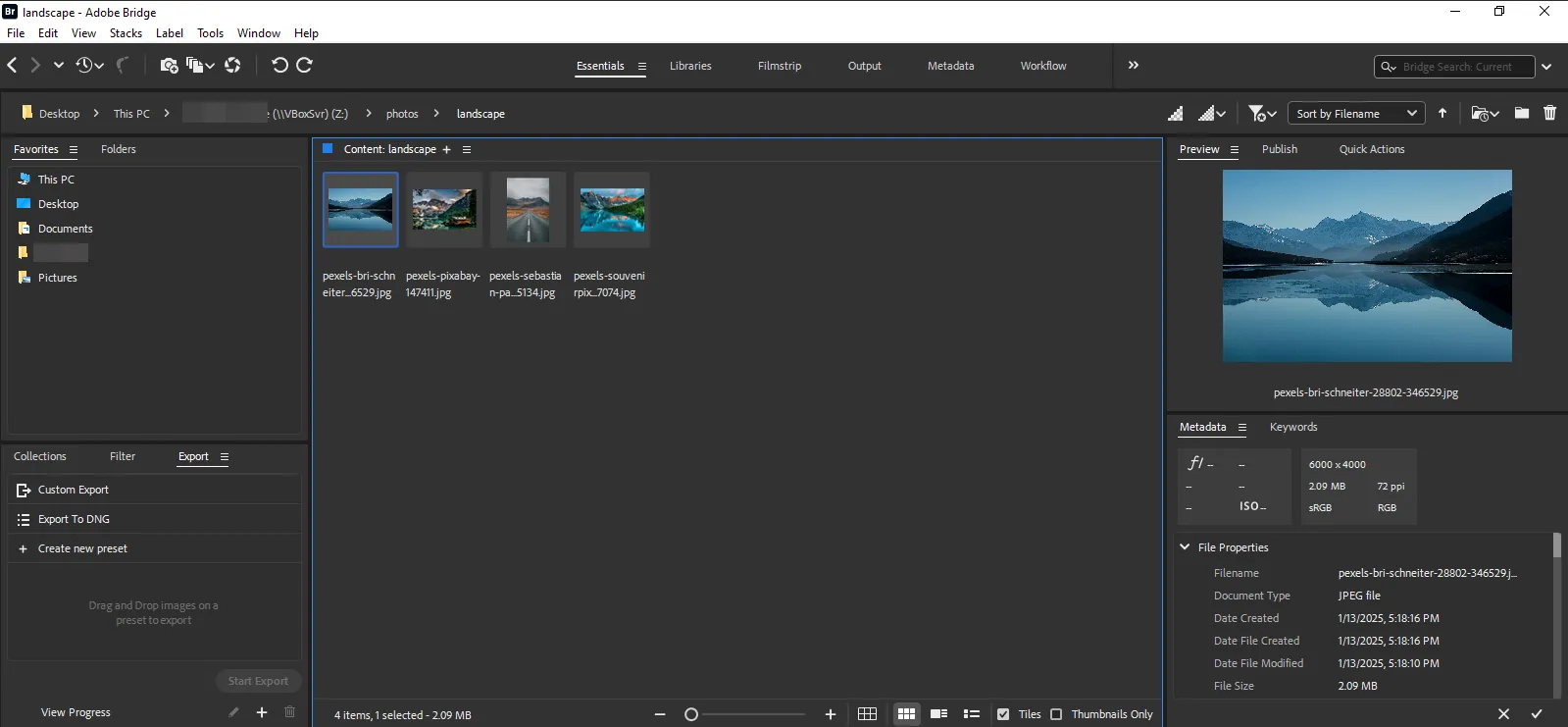
Despite the lack of some options, the program has powerful automation tools. In particular, you can set an algorithm so that all selected photos are cropped to a certain resolution. If you need to perform deep color correction, you can install the Camera RAW plugin.
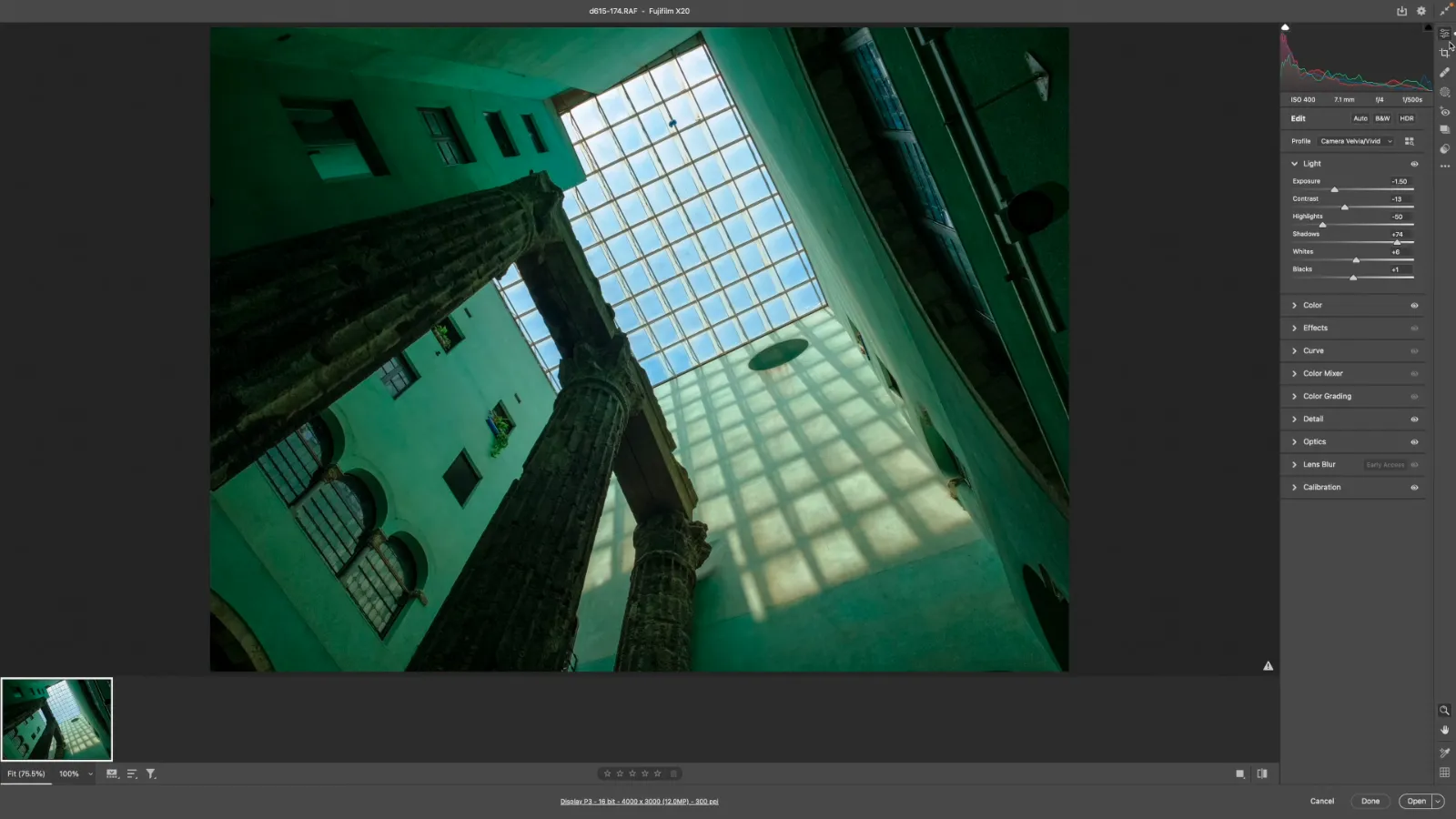
Adobe Bridge offers powerful tools for working with metadata and keywords. The latter allow you to quickly filter and search for the required image.
Benefits of the program
- The program is free, but you must have a Creative Cloud account to download and use it.
- Easy integration with other Adobe products, the ability to install plugins to expand functionality.
- Allows you to add and edit metadata (EXIF, IPTC), making it easier to search and sort files.
Disadvantages of the program
- High demands on computer system resources.
- The free version supports a limited number of plugins for installation.
- Intrusive advertising for purchasing a paid subscription in the Creative Cloud application, which launches with Adobe Bridge.
Photo editors and other complex software solutions
ADCSee
ADCSee is an expensive professional program that will not only solve the problem of storing and organizing photo files, but also help with editing them.
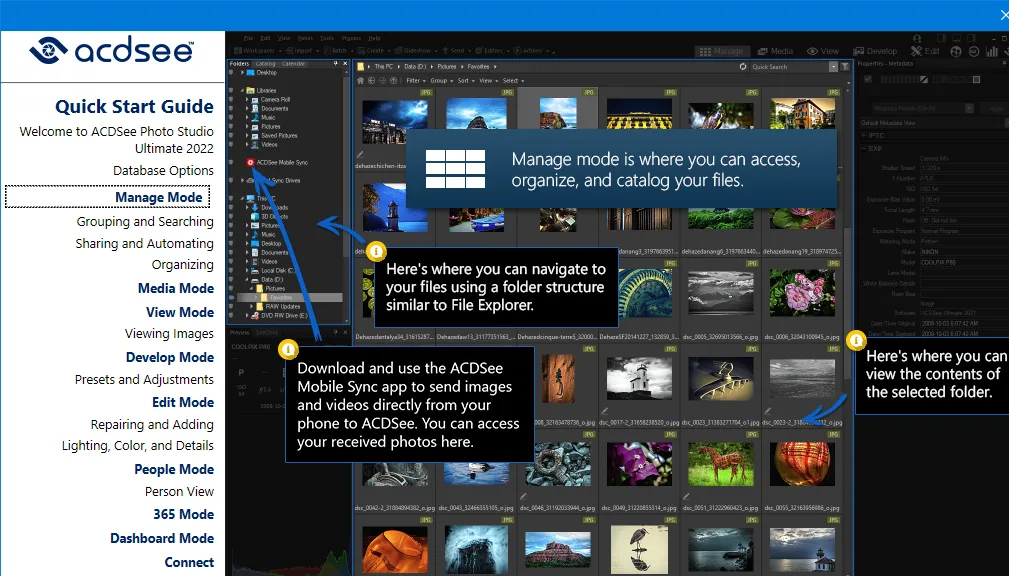
The interface is a little busy. But it is partially customizable. In particular, you can remove unnecessary tool icons in the toolbar.
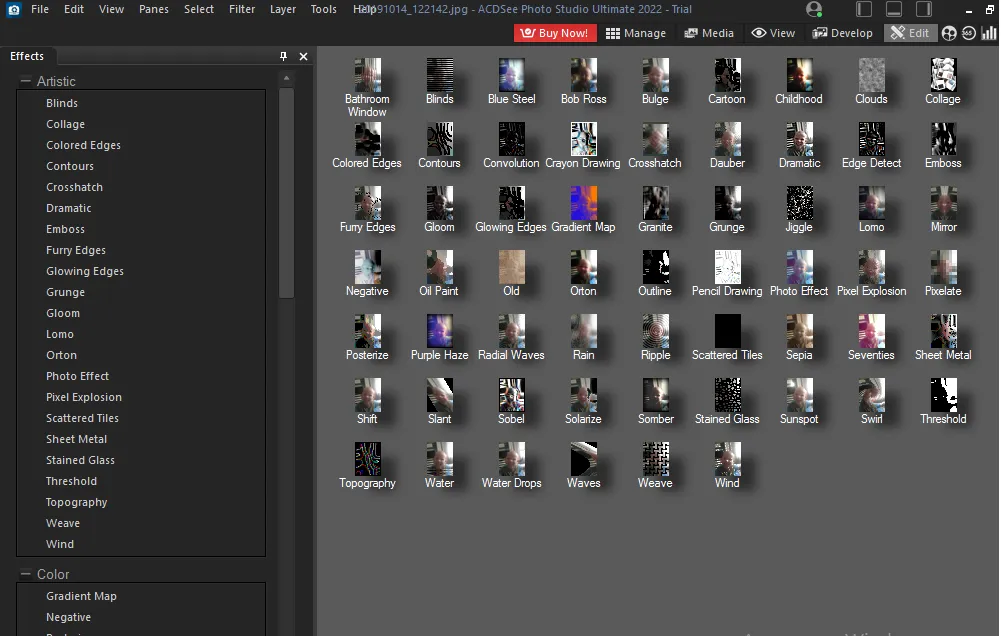
The program can be tested for 30 days free of charge. Then, the cost starts from $59.99. For the professional version, you need to pay 2-3 times more. But the prices are not stable, from time to time there are various promotions on their website.
Advantages of the program:
- There are tutorials for beginners.
- Face recognition function, as well as other "catalog" tools, such as displaying photos on a map and on a timeline.
- Using the program, you can remove duplicate photos.
- Integration with social networks.
- Support for various image formats, including HEIC and RAW.
Disadvantages of the program:
- In the trial version, reminders about the ending period of validity constantly pop up.
- Complicated interface overloaded with various tools. A beginner can be embarrassed by seeing such a variety of functionality.
Adobe Lightroom
A graphical editor for processing digital images also does a good job of viewing photos, especially Raw-format. Although now it is not really an application, but more of a cloud service with a desktop app. Together with the subscription, a space in the network storage is paid.
The application will help you adjust professional shots. A set of tools for editing, color correction, retouching is very good here. This program is available for free.
Advantages of the program:
- Intuitive interface.
- It works great with Raw files.
- There is a "Before and after" ability to compare the result of work with the source.
- The original photo remains unchanged.
- Presets and saved settings.
Disadvantages of the program:
- Lightroom is primarily a graphics editor for digital image processing.
- An outdated approach to the "digital negatives" development workflow.
- Adherence to the sanctions policy.
SILKYPIX Developer Studio SE
SILKYPIX Developer Studio SE is a full-featured lab for developing digital negatives. Created by Japanese engineers, the program is designed for professionals who require precise RAW file processing. It is based on a unique algorithm that produces incredibly smooth color transitions and natural skin tones.
The SE (Special Edition) version means the program is bundled with cameras (Panasonic, Fujifilm) and is configured for maximum performance with sensors from these manufacturers. This isn't the kind of software you open just to "look at photos"; it transforms a drab image into a true work of art.
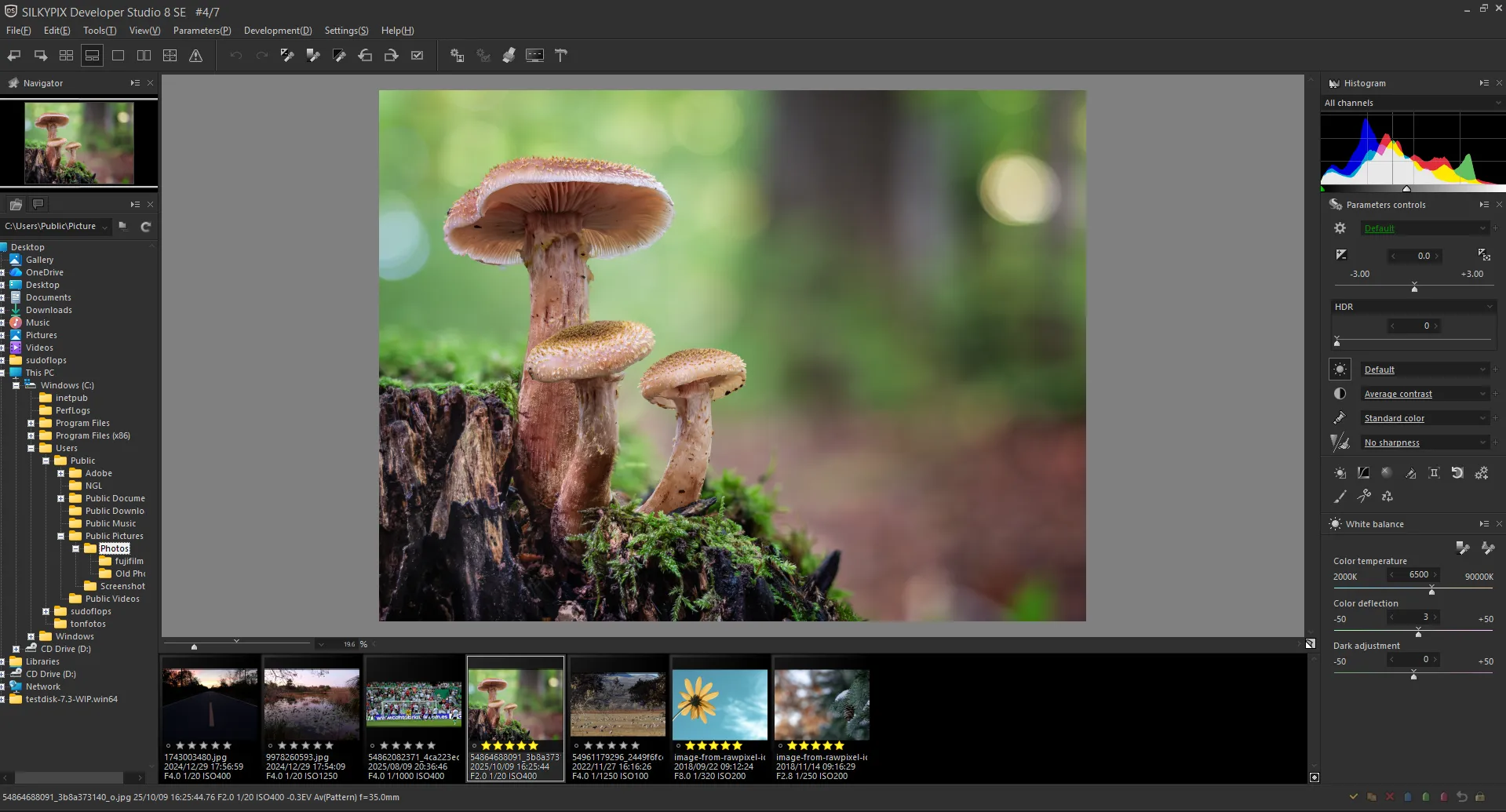
The program offers a unique approach to color and sharpness management, which differs significantly from Western equivalents (like Adobe). It features specialized tools for combating digital noise without losing texture and batch processing capabilities, allowing you to apply complex edits to hundreds of frames simultaneously.
Advantages of the program
- Benchmark development quality. The program's algorithms minimize artifacts and ensure a clean image even at high ISO settings.
- Complete control. A huge number of tools for adjusting exposure, dynamic range, and lens distortion.
- Batch processing. High efficiency when working with large photo shoots: settings from one frame are instantly replicated across the entire set.
- Japanese reliability. Stable processing of RAW files from supported manufacturers and regular updates for new camera models.
Disadvantages of the program:
- A unique interface. The Japanese design school implies an abundance of small icons and tabs. A beginner might find the interface cluttered and unintuitive.
- Brand restrictions. SE only opens RAW files from its own manufacturer (for example, the Panasonic version won't open files from Sony).
- Resource requirements. Deep mathematical processing requires good RAM and a processor; otherwise, the visualization of changes may slow down.
- Difficulty of learning. To unlock the full potential of the "laboratory," you'll need to spend time studying the manuals.
FUJIFILM X RAW STUDIO
FUJIFILM X RAW STUDIO differs from other RAW converters in several ways. First and foremost, it doesn't burden your computer's processor with complex calculations. Instead, it connects to your Fujifilm camera via USB and uses the powerful built-in X-Processor to develop RAW files.
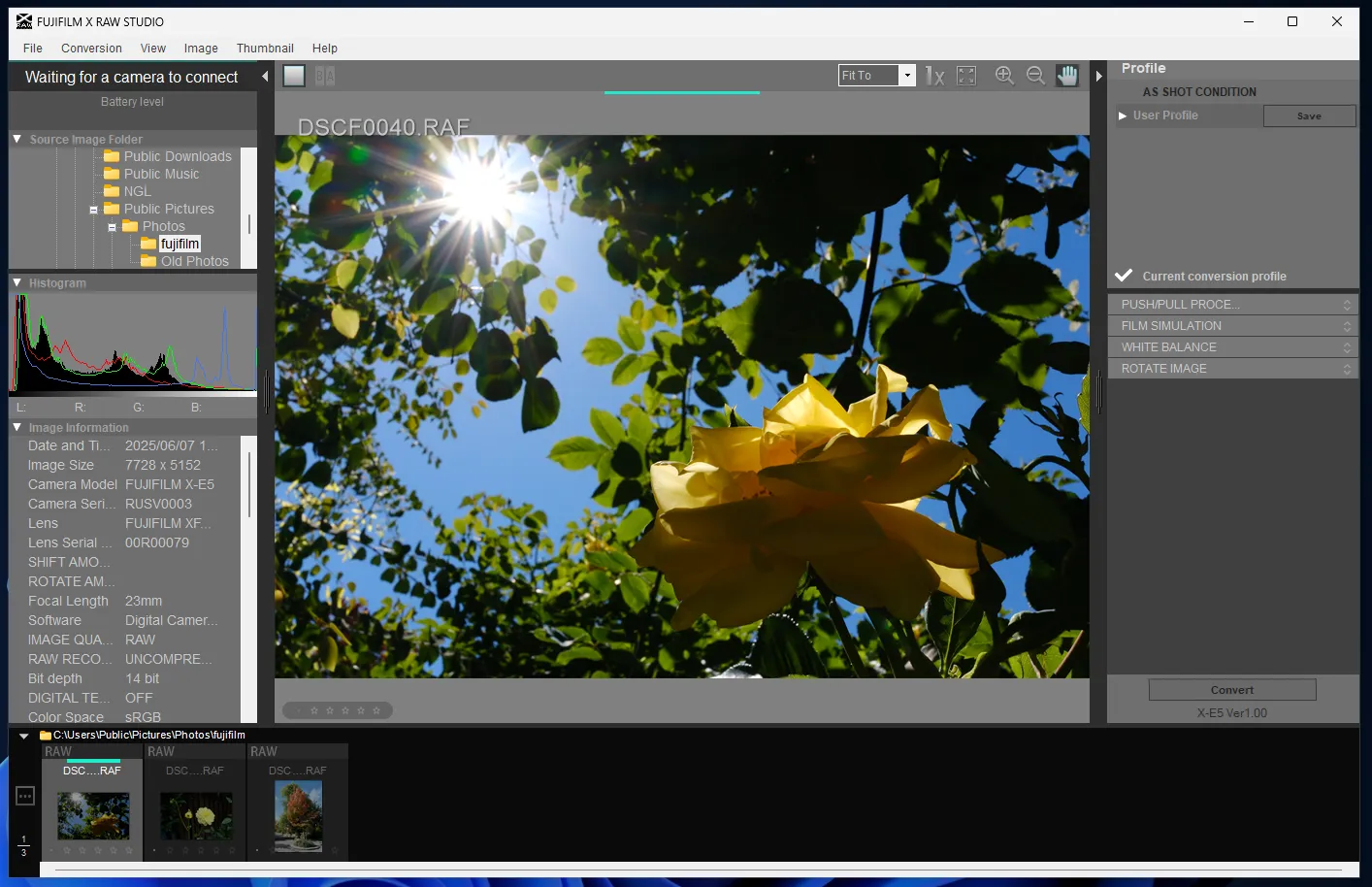
Since the camera handles the processing itself, you get exactly the same result as with an in-camera JPEG, but with the ability to change any parameters: from Film Simulation to white balance and grain.
Advantages of the program
- Color Identity. Get 100% color matching with camera profiles (Classic Neg, Eterna, Acros), something impossible to achieve with third-party converters.
- Phenomenal speed. Since the camera's processor handles the calculations, conversion happens almost instantly without overheating your laptop.
- Saving profiles. You can create your own unique processing recipes on your computer and instantly load them into the camera's memory for future shooting.
- Free. The program is available for free download to all owners of supported Fujifilm X-series and GFX-series cameras.
Disadvantages of the program:
- A physical connection is required. You won't be able to edit photos on the go without the device itself.
- Limited functionality. There are no retouching, dust removal, or local adjustment tools. Only global "development" options.
- Model-specific. Available settings in the program directly depend on the capabilities of the connected camera.
- For Fujifilm only. For owners of other systems, the program is completely useless.
darktable
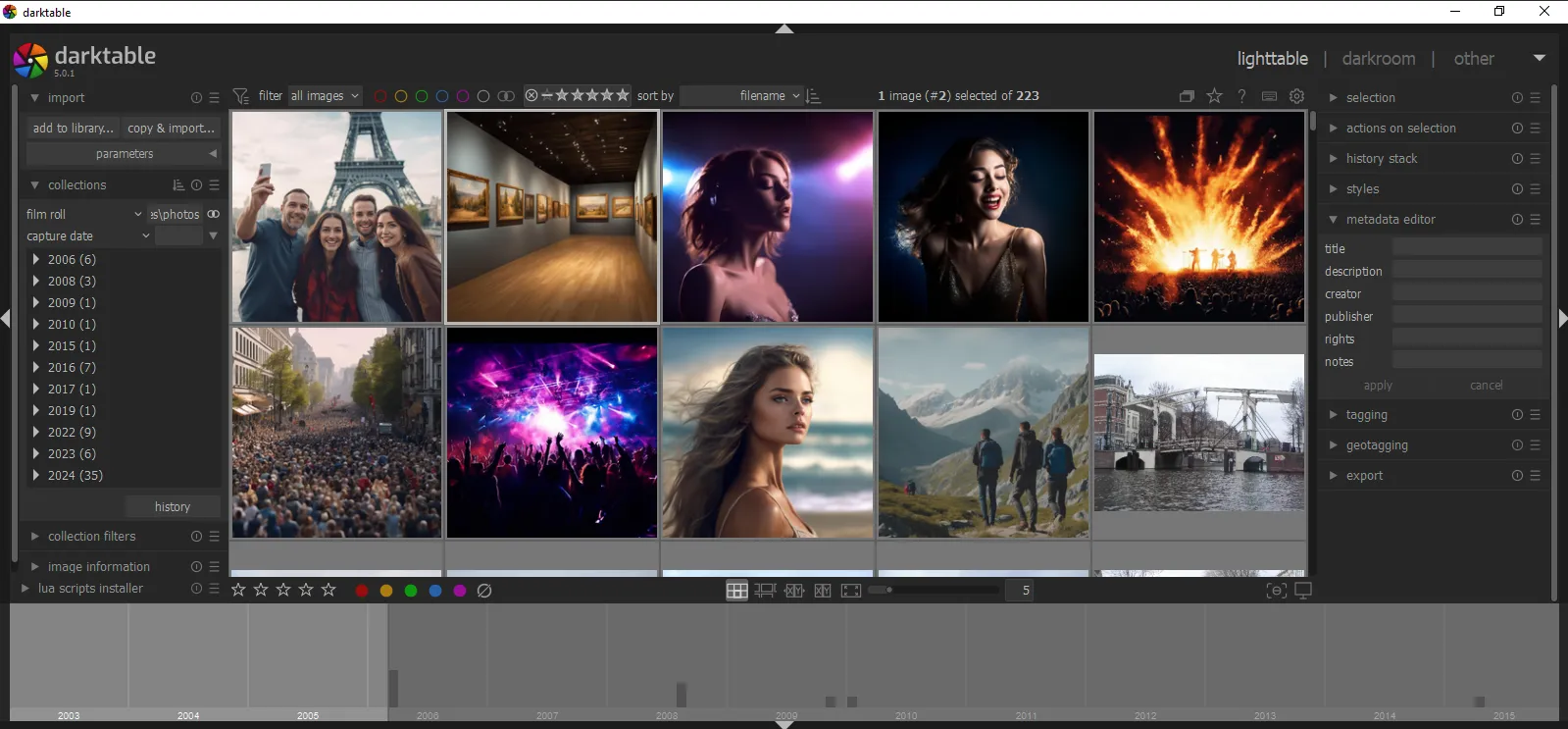
First of all, darktable is a free open-source program designed to perform primary processing of digital negatives in RAW format, but it can also be used as a browser. In addition, it has the necessary tools for sorting and cataloging photo archives. In particular, the ability to view photos in chronological order, visualize geotags on a map, filter images by keywords and other metadata.
Like many open-source projects, darktable suffers from an overloaded interface, so it may seem incomprehensible to users whose activities are not related to photography or graphic design.
Benefits of the program
- darktable is a completely free program for both home and commercial use.
- Works on Linux, macOS and Windows, which allows you to use it on different operating systems.
- It copes well with processing and viewing RAW files, which is important for professional photographers.
- Built-in cataloging tools like tags, ratings, and metadata help you easily find and sort your photos.
Disadvantages of the program
- The interface and functionality may seem complicated for users who are just starting to work with photo processing.
- Performance decreases when working with large image libraries.
- A complex procedure for installing additional plugins and scripts to expand the capabilities of the program.
Cloud Services
Cloud storage is a convenient and practical solution. So why not "practice" sorting and organizing these files using a service that specializes in working with network storage?
iCloud/iPhoto
iCloud/iPhoto is a real ecosystem for Apple devices. Uploading to the cloud is automatic, and working with photos is as simple as possible, there is device synchronization. Sharing a photo with a friend or relative is easy.
There is a free plan for 5 GB. Unfortunately, it is quite difficult to pay for its use at the moment if you want to buy more storage space.
Advantages of the service:
- Always at hand. Excellent sync.
- Intuitive, easy interface.
- Face recognition, and other sorting options.
Disadvantages of the service:
- Strong binding to the Internet and apple devices.
- Friendly only to users of the Apple ecosystem.
Google Photos
As an app, the service is only available on mobile devices. On a desktop computer, it is supposed to be used through a browser via a link.
The service not only shows and sorts previously uploaded photos, but also allows you to partially edit them.
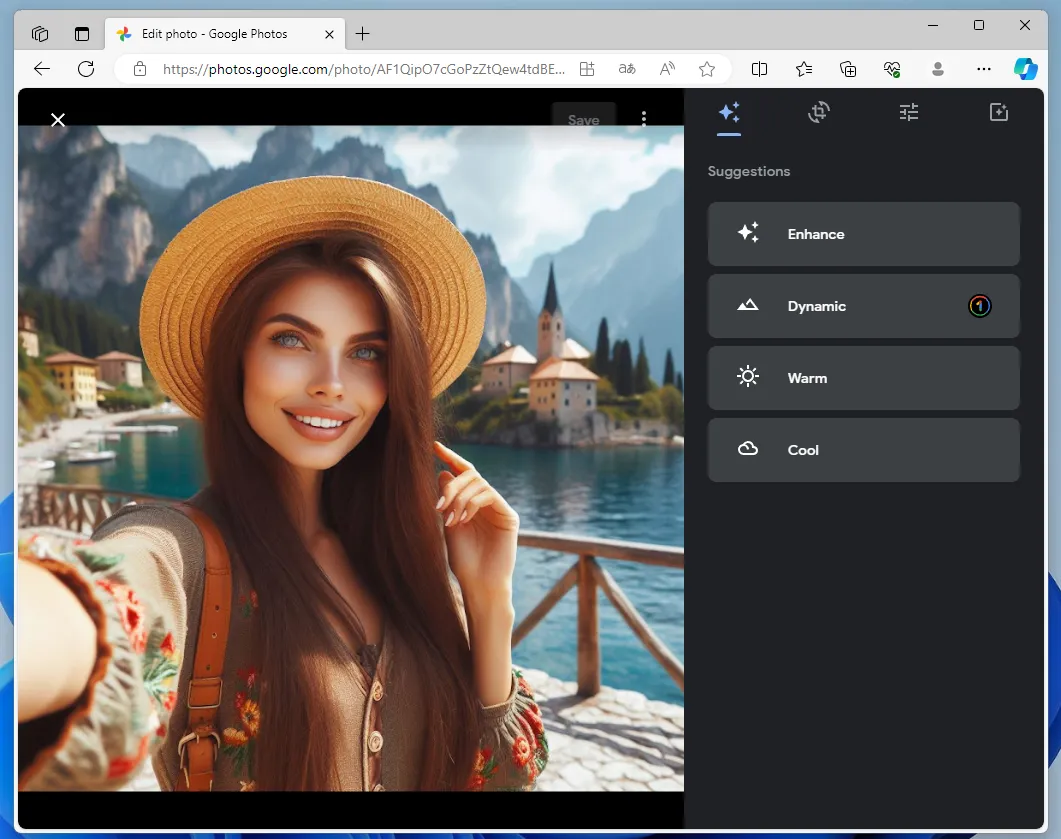
Also, like most similar services, it offers users to use the storage for free up to 15 GB, and if you need more, then you need to buy a subscription.
Advantages of the service:
- Simple and easy navigation.
- Recognition of people and animals in the photo.
- Possibility of simultaneous work from one account on several devices at once.
Disadvantages of the service:
- Google trains its neural networks based on user data and has the right to include them in targeted advertising.
- Binding to a stable working Internet.
- Weak editing features.
Amazon Photos
Amazon Photos is a photo storage service from the world leader in cloud technologies. The service provides all registered users with the ability to store up to 5 GB of multimedia content on the server. With a Prime subscription, you can upload an unlimited number of photos, and the 5 GB limitation will only apply to videos. In addition, you can purchase additional space separately.
Compared to Google Photos, the Amazon Photos interface has a minimalist design. The main reason for this is its more modest functionality.
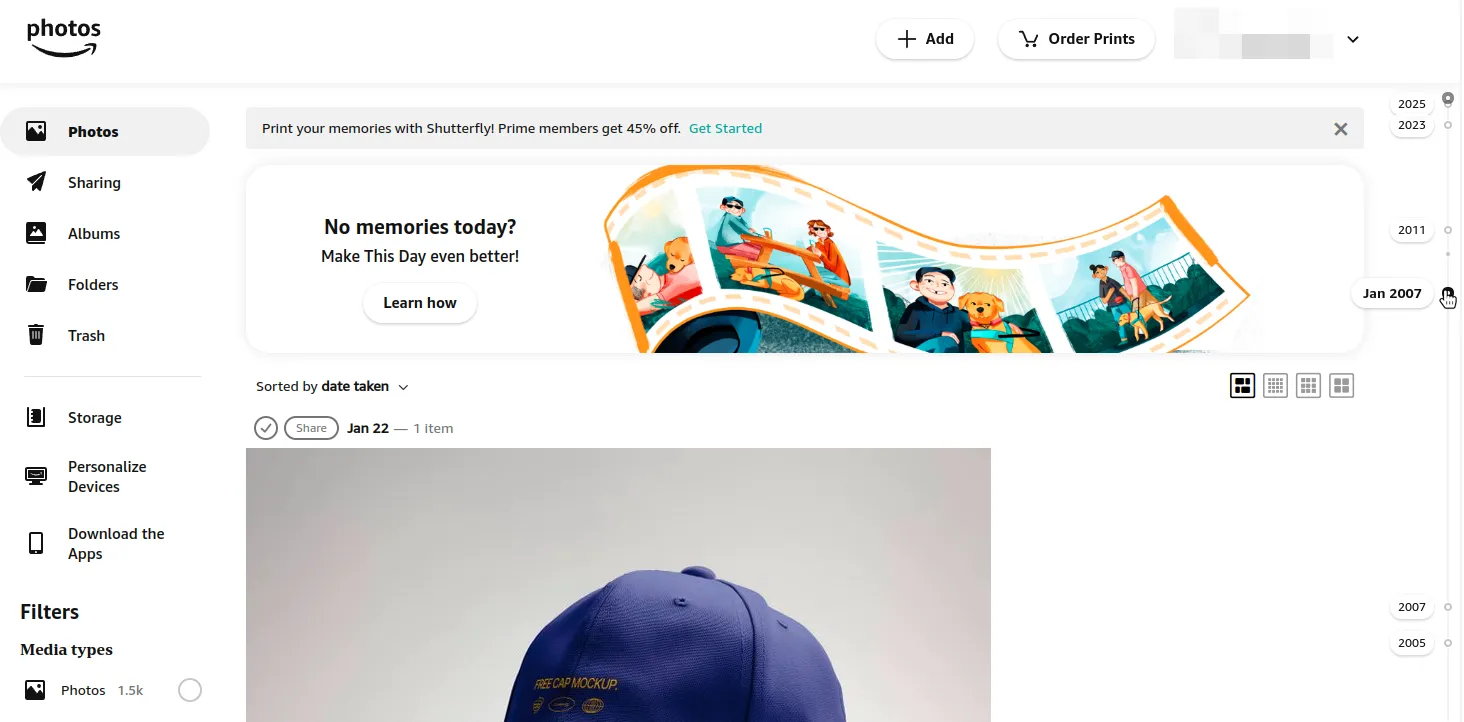
The service provides a minimum of functions for sorting and cataloging. The user can only view photos in chronological order or distribute them into albums. Amazon Photos doesn't have facial recognition, metadata editing, or geolocation tag rendering features. Basically, it's just a photo backup tool.
Benefits of Amazon Photos
- Amazon Prime users get unlimited storage for photos in original quality, making the service attractive to those who already have a subscription.
- Amazon Photos can automatically back up photos from your phone or computer. This ensures that your photos are safe even if you lose your device.
- You can easily share photos with friends and family by sending them links to albums or individual photos.
Disadvantages of Amazon Photos
- Users only get 5GB of photo and video storage for free.
- Amazon Photos does not offer facial recognition or geotagging on a map.
- The service has minimal capabilities for sorting photographs, which does not allow efficient cataloging of large photo archives.
Simple utilities
Utilities are small programs that perform a specific function. In this regard, they solve a limited set of tasks, which are opening the photographs and, possibly, their partial correction.
Photos (Microsoft Photos)
Perhaps the most common photo viewer is Photos (Microsoft Photos). The latest versions for Windows 10 and 11 have stepped forward. The functionality of the program has been revised. Now it is not only an image viewer, but also an editor with which you can create your own movie (slide show), as well as a manager for organizing the photo archive.
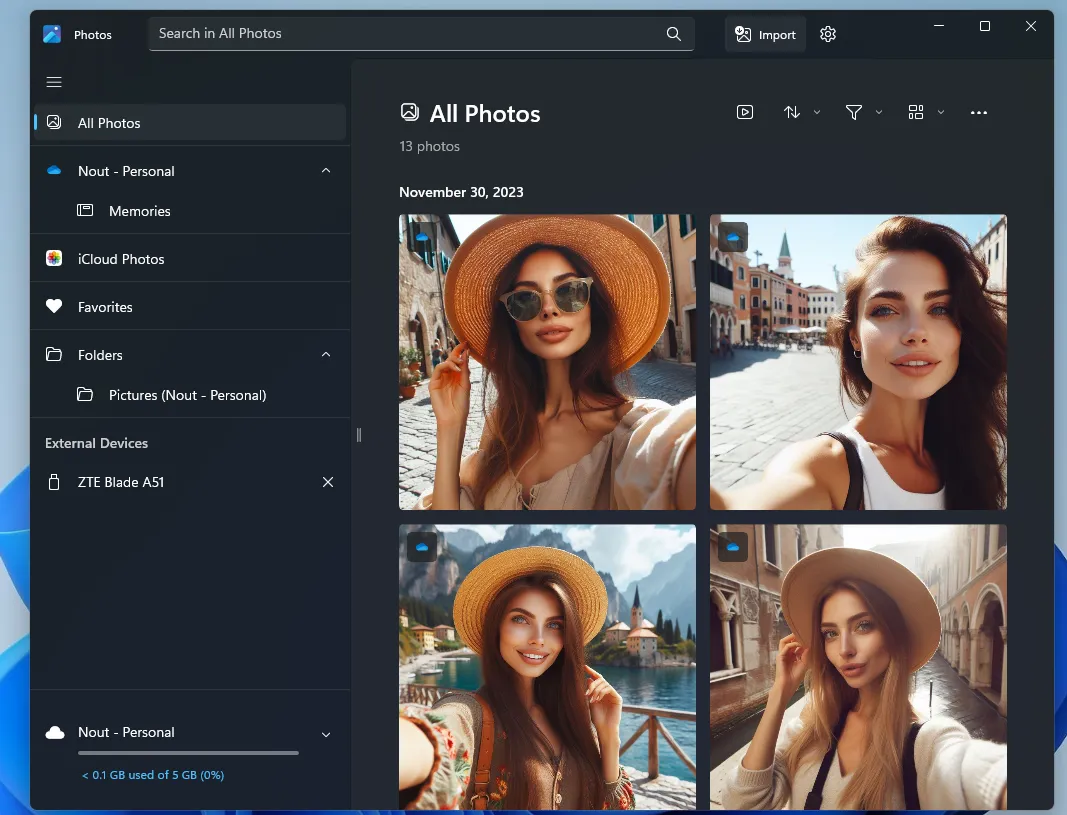
The program is available for free. It goes hand in hand with other programs.
Advantages of the program:
- There is a basic set of photo editing tools (cropping, slight color correction, retouching).
- Cataloging system. Images are indexed, also there is a timeline, a search with recognized faces, a feed with photos and other useful features.
- Modern design. It is concise and simple.
Disadvantages of the program:
Not everything is so perfect with this program. The design looks stylish, but it is not clear enough how the functionality of some solutions is implemented. An unprepared user, without “Google help”, may not immediately find, for example, where the slide show editor is hiding.
Users also often note that updated photos with enhanced functionality may not work as correctly as their counterparts. One gets the impression that the program has not yet been “run in” and some roughness arises with its work.
And the program itself is closely related to cloud storage. But buying a space in it is already a controversial issue, which should be considered in another article.
NeeView
NeeView is somewhat different from traditional photo viewers. It's more like a "browser" for your photos, in the most literal sense. The program's interface closely resembles a web browser (with an address bar and navigation buttons). It even allows you to browse images like pages of a book.
The program can handle "spreads," displaying two images side by side, allowing you to view your shots in a new context, like the pages of a designed album. NeeView is also an open-source (FOSS) project, meaning there's no board or unnecessary telemetry.
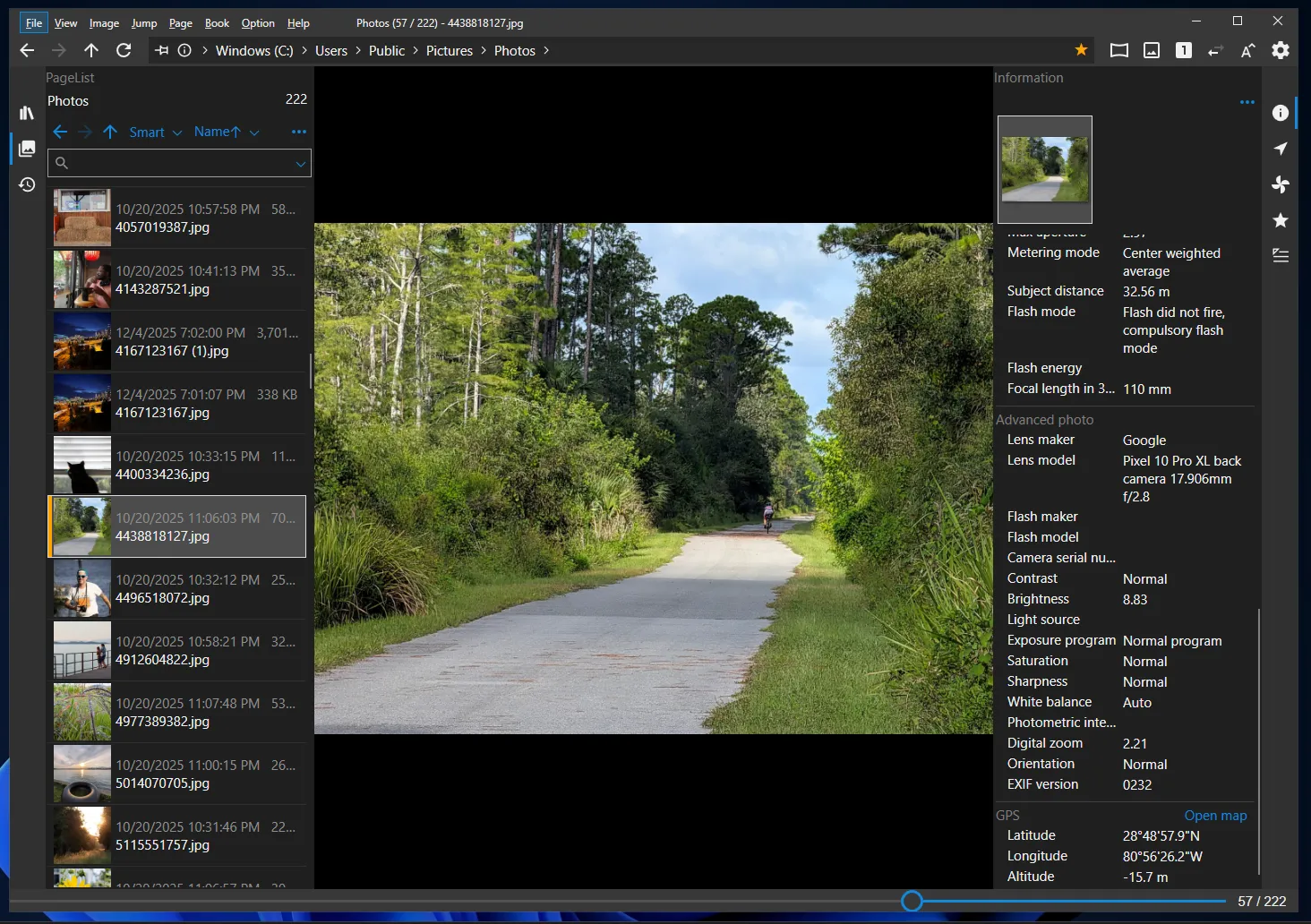
There's a history system ("Recent Books"), playlist support, and file grouping. Most importantly, you don't have to worry about how your files are stored: in a folder or in an archive. You can view photos inside ZIP, RAR, or 7z files as easily as if they were regular directories, without the hassle of unzipping them.
Advantages of the program
- Book mode. Ideal for evaluating the composition of paired shots or viewing finished photo books.
- Omnivorous archives. The program "sees" the contents of compressed files, including subfolders, saving disk space.
- Video and PDF support. NeeView can replace several utilities, allowing you to view videos and documents in the same interface.
Disadvantages
- Entry barrier. Due to the abundance of settings and the specific logic of the "book" view, it may take a beginner some time to get used to the navigation.
- Windows only. The app is written in .NET and optimized exclusively for the Windows ecosystem.
- Unique design. The interface with the address bar may seem strange to users accustomed to classic file explorers or tile-based browsers.
PicView
PicView exemplifies what a modern image viewer should look like in 2026. It's a lightweight, open-source app that prioritizes aesthetics, speed, and support for the latest standards.
The program fits seamlessly into the interface of modern operating systems (Windows 11 and macOS). It's also highly adaptive. PicView can operate in a completely frameless mode, hiding all unnecessary elements, leaving you alone with the photo. And under the hood, there's a powerful engine that instantly captures not only familiar JPGs, but also heavy RAW, WebP, HEIC, and even the latest AVIF or JXL formats.
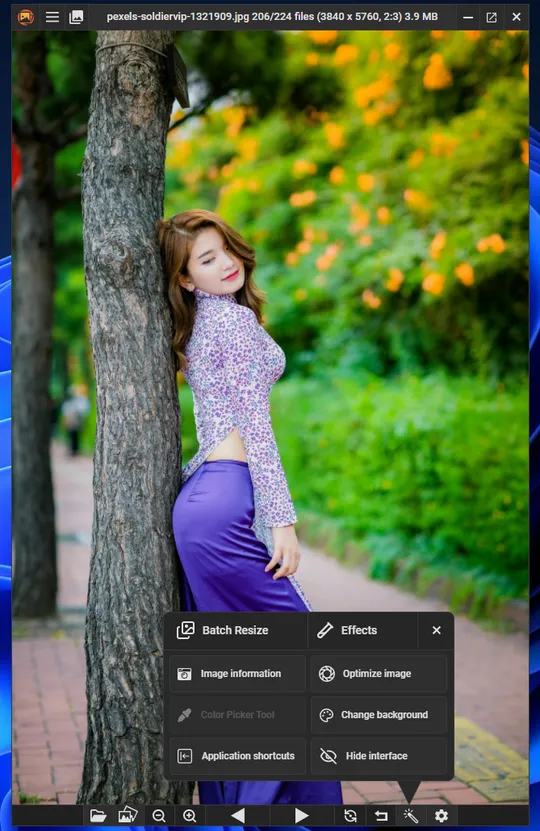
PicView also has several unique features rarely found in traditional viewers. For example, the ability to pin photos to the top of all windows (handy for designers) and a built-in tool for optimizing and compressing images on the fly without losing quality.
Advantages
- Modern design. Support for transparency, dark themes, and a fully customizable interface without visual clutter.
- Omnivorous. Easily handles formats that standard applications struggle with (SVG, PSD, specialized RAW profiles).
- Speed and lightness. The program weighs less than 10 MB and launches almost instantly, without impacting the system.
- Privacy and purity. No telemetry, ads, or intrusive updates—just pure code.
Disadvantages
- Minimalism in file management. If you need a folder tree like Explorer or a complex tag system, PicView may seem too simple.
- Basic editing. Editing tools are limited to cropping, rotating, and applying simple filters. Retouching will still require an external editor.
123 Photos: View, Edit & Convert
123 Photos is a great alternative to the standard Windows viewer that doesn't stumble on specific formats. This program is designed for those who value speed and modern aesthetics but aren't ready to navigate cluttered menus.
The app easily opens over 60 formats, including complex ones like psd (Photoshop), .ai (Illustrator), .heic (Apple), .webp, and even .dicom medical images. 123 Photos uses hardware acceleration, ensuring instant zooming and smooth animation, even when working with large, high-resolution images.
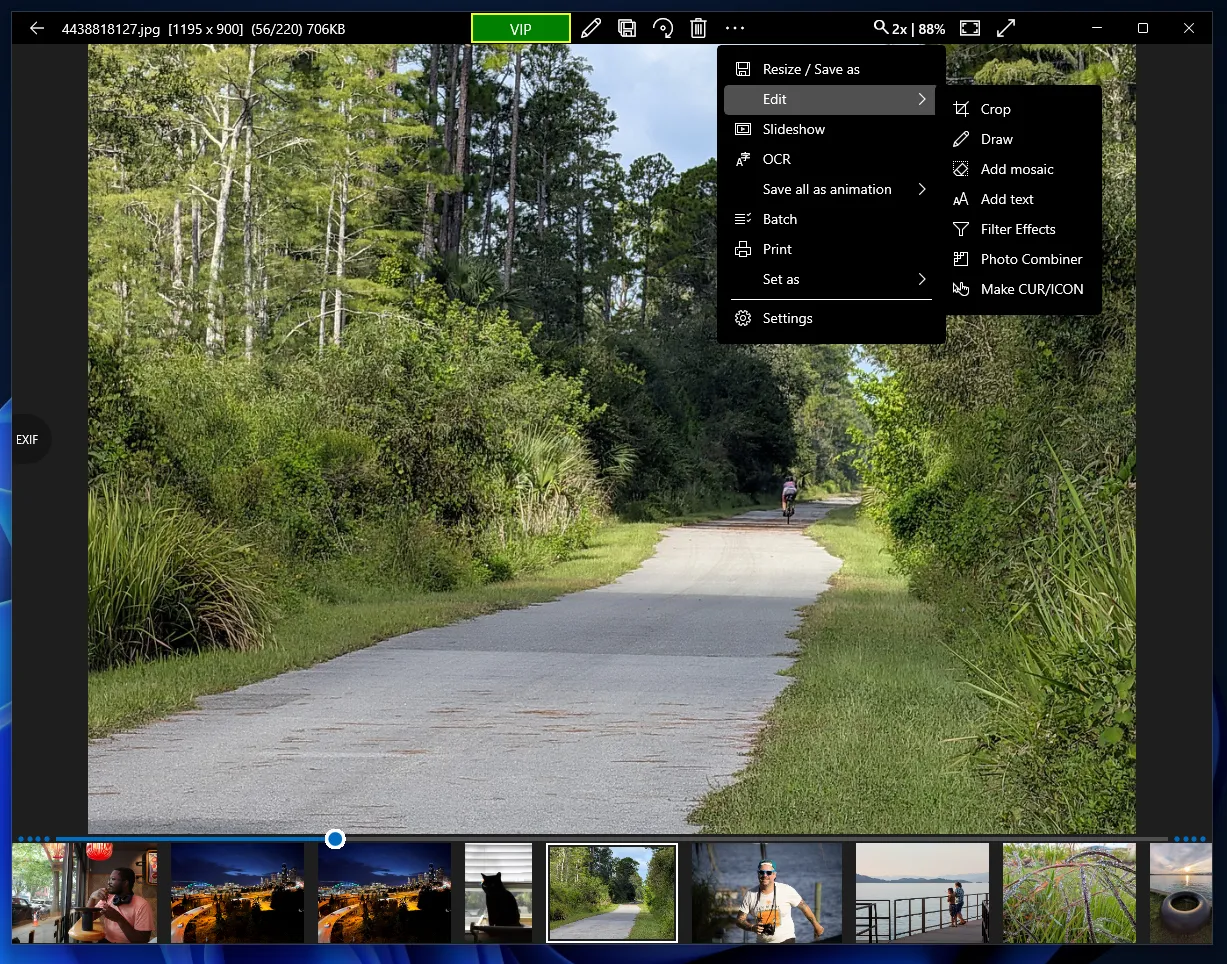
In terms of usability, 123 Photos is mouse-centric: clicking on the edges of an image switches frames, and the wheel controls zooming. It lacks the complex cataloging system of Tonfotos, but it does have a built-in image converter and editor.
Advantages
- Support for rare formats. Opens design (PSD, AI, SVG) and texture (DDS, TGA) files without third-party codecs.
- High speed. Thanks to hardware acceleration, the program runs very responsively even on low-end PCs.
- Modern interface. Support for over 10 themes and intuitive navigation.
- Advanced cropping. Crop photos at any angle or straighten perspective.
Disadvantages
- Monetization. Viewing is completely free, but saving edited files or batch conversion requires a subscription or one-time purchase.
- Windows only. The app is available exclusively through the Microsoft Store, limiting access to users of other operating systems.
- Ads. The free version may contain banner ads, which can be removed by purchasing a license.
Sakura Photo Viewer
The program is designed for those who don't want to overload their system with complex databases but value easy navigation. For example, you can simply click on a date to instantly jump to photos taken on that day. This makes Sakura an excellent tool for quickly browsing family archives organized by time.
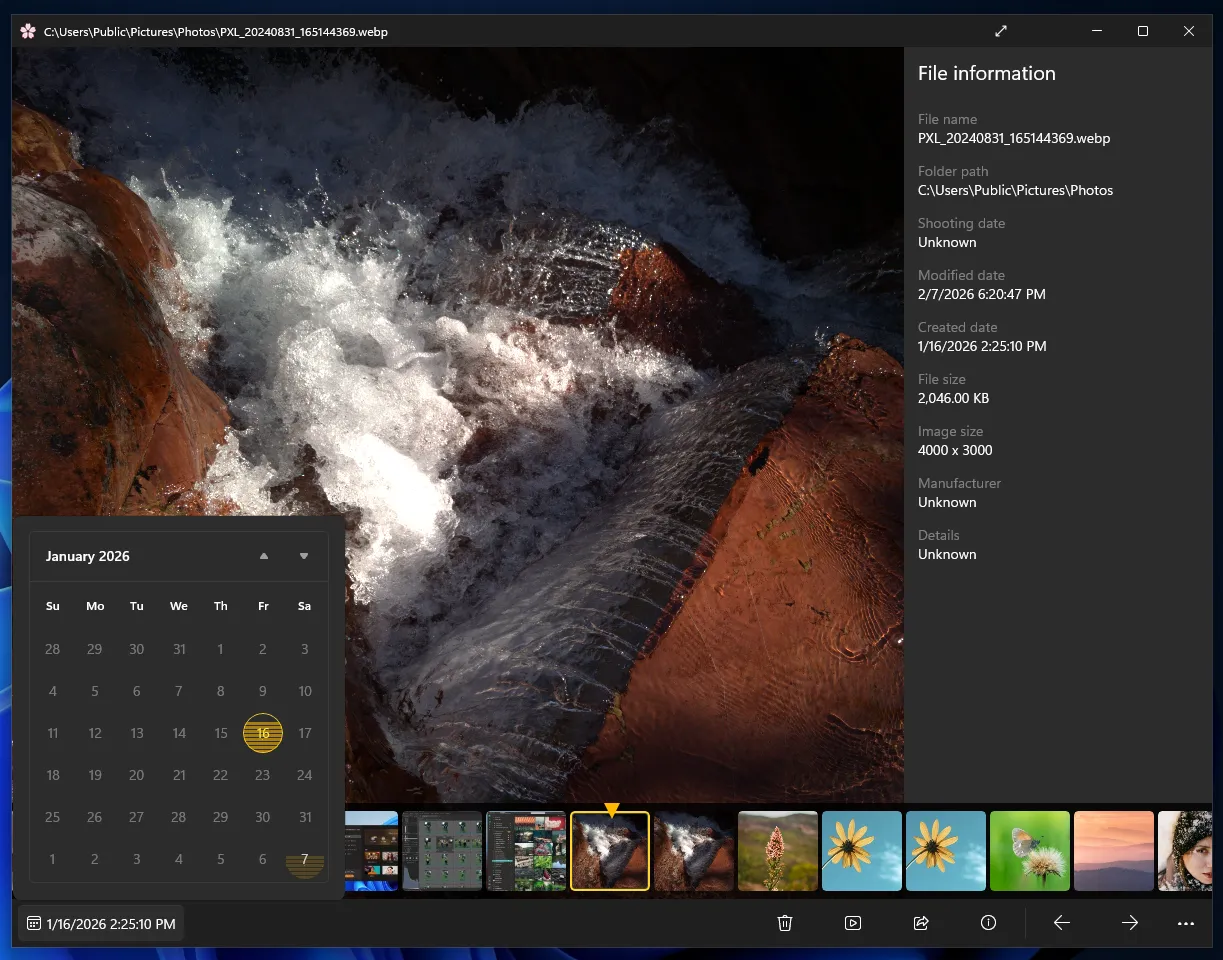
Despite its simplicity, the program supports multiple displays (show photos on a second display with a double-click) and features deep system integration. You can set your desktop and lock screen wallpapers directly from the Sakura Photo Viewer window.
Advantages of the program
- Lightweight. The program launches almost instantly and takes up minimal RAM.
- Calendar search. A handy feature for those who remember events by date rather than folder names.
- Continuous scrolling. When viewing thumbnails, all photos are displayed in a single stream, making it easier to find the right photo in a large folder.
Disadvantages
- Minimalistic functionality. There are no editing tools, facial recognition, or complex tagging system.
- For Windows 11 only. The app is tightly tied to the Microsoft Store and the Windows platform.
JPEGView
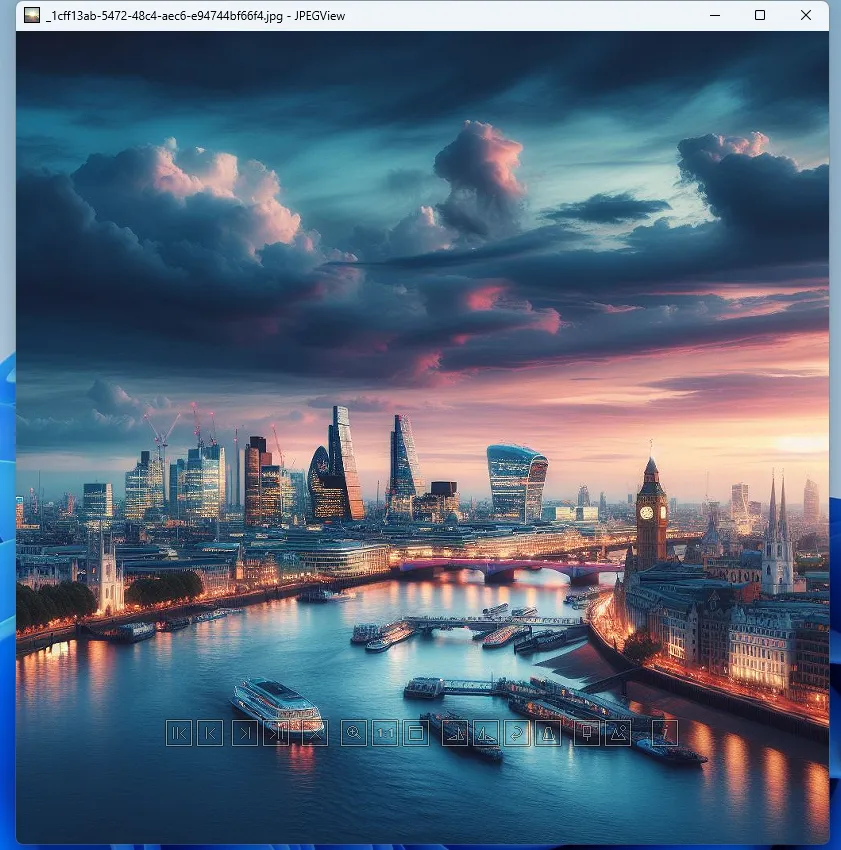
JPEGView is a concise and weightless program thing (namely, a "thing", since it takes up only 1 MB of disk space), and it performs only one function, which is opening a photo. Moreover, the opening of even a heavy image.
We can say that the principle of this application is “photos and nothing more”. Perhaps that is why the application has a specific design. In fact, this is one line with a toolkit in windowed mode.
The program is free and available for download at any time. Only now you need to pay attention to the resources where it is located. According to Wikipedia, the link to the official website leads to the project on GitHub, where you can download the desired file.
Advantages of the program:
- Small volume.
- It opens the most popular graphic formats. For Raw files, it uses software components from OC Windows.
- There is a minimum set of tools for color correction. (Available in full screen mode. To activate it, move the cursor down the image).
Disadvantages of the program:
- Available for Windows only.
- Unusual design, or rather, its complete absence.
nomacs
nomacs is a photo viewer with a lightweight and simple editor. Supports many graphic formats, including Raw, HEIC.
Has a good functional set of tools
- Batch processing;
- Translucent widgets;
- Search with filters;
- Multiple viewing and navigation modes.
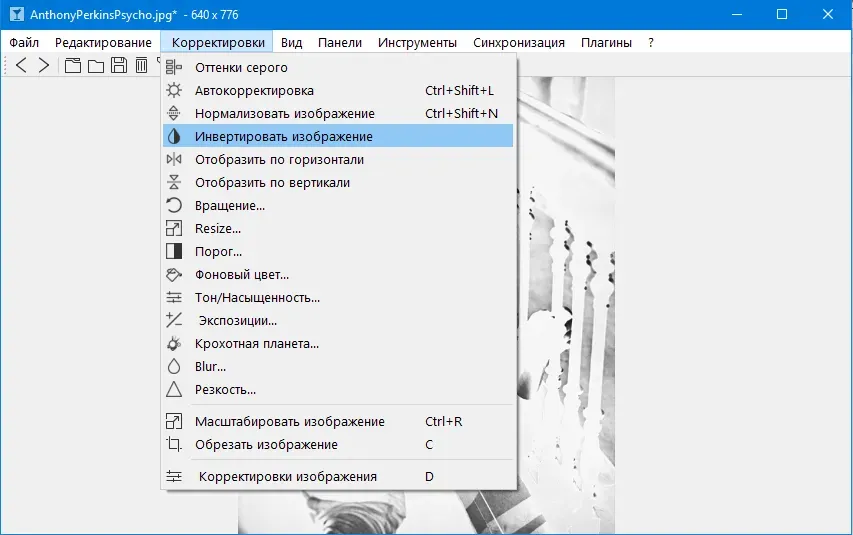
Donation software. The latest version 3.16 is available for download on the official website.
Advantages of the program
- Availability for installation in various operating systems. Open source.
- High speed operation.
- Binding to Google-maps. You can see where a particular picture was taken.
- Only works with 39 photo formats, but the most popular.
Disadvantages of the program:
- Outdated design.
- "Scratches the surface." All the functionality is superficial, and made to a minimum.
BandiView и Honeyview
This section is dedicated to two programs from the same developer: the legendary Honeyview viewer, which ranks alongside such well-known tools as IrfanView, XnView, and FastStone Image Viewer, and its successor, BandiView.
Honeyview has long been a leader among lightweight image viewers. It was beloved by users for its lightning-fast speed and the unique ability to view images inside archives (ZIP, RAR, CBR, CBZ) without unpacking them. However, in June 2024, the final version was released, and support for the project was discontinued. However, it can still be downloaded from the developer's official website.
In turn,Bandisoft not only does it retain the functionality of its predecessor, but it also adds new features. For example, you can now take HDR photos, convert them to other formats, and view image queries generated by Stable Diffusion.
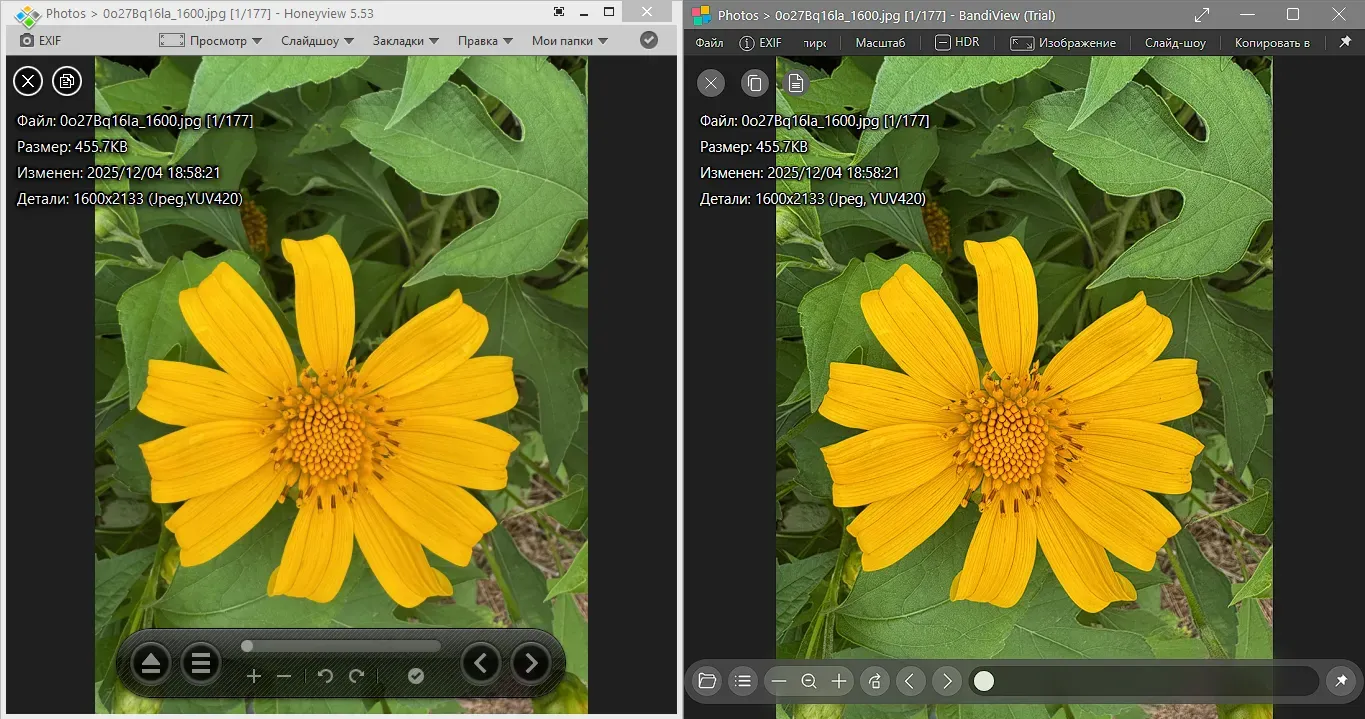
True, Honeyview was completely free, while BandiView is distributed as shareware. However, if you simply need a browser or have an older computer that's poorly compatible with modern software, the "old man" Honeyview remains an ideal choice.
Advantages
- Working with archives. Both programs can open photos and other images directly from archives.
- HDR (BandiView) support. The new version is capable of displaying images with a high dynamic range.
- Webtoon mode (BandiView). A convenient feature for reading vertical comics. The program stitches images together into one long strip.
- Format omnivorousness. Honeyview opens all classic formats (JPG, PSD, RAW). BandiView supports HEIC, professional graphics (Clip Studio Paint), and the latest AVIF and JXL.
Disadvantages of the program:
- System requirements. BandiView will not run on 32-bit systems or older Windows versions (7/8). Owners of such hardware will have to stick with Honeyview.
- License. Honeyview was completely free. BandiView's transition to shareware implies possible restrictions or future purchase offers.
- Honeyview is no longer being developed. The old version will no longer receive security updates or new features.
Imagine Viewer
A simple and intuitive program. Initially resembles a classic photo viewer. But when the image is opened, the frame itself becomes the center of attention. The user interface is highly customizable.
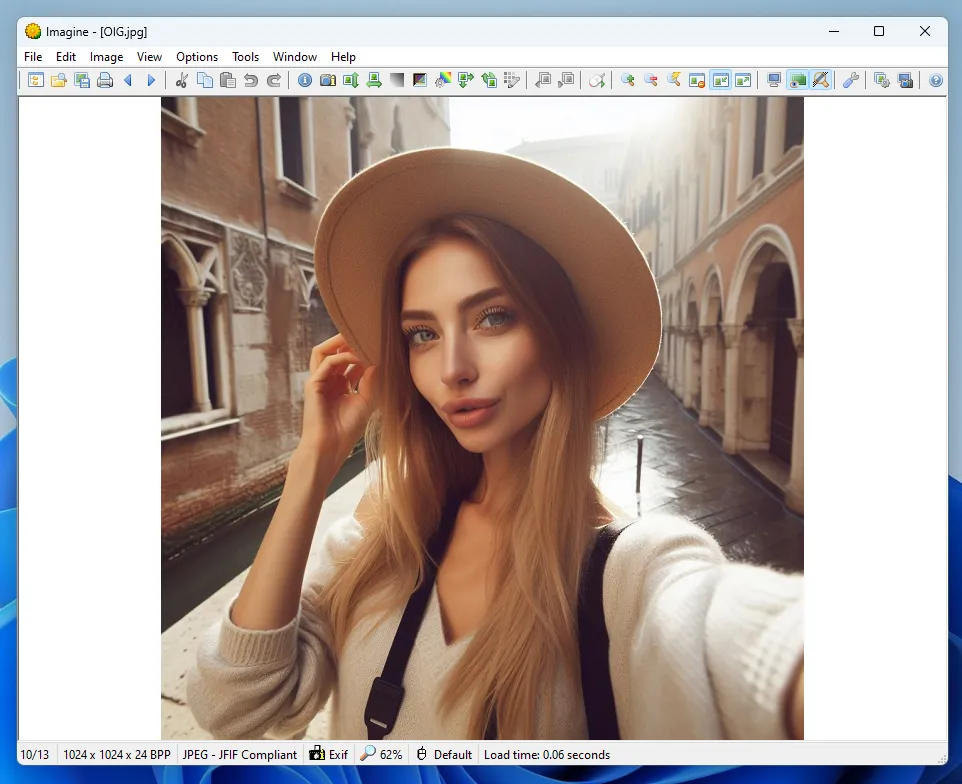
There are some photo editing tools, and you can also create slideshows or even animations. Also among the services there is a batch conversion and other useful features.
You can download the latest versions of the program for free on the website.
Advantages of the program:
- Support for popular graphic formats.
- Batch work.
- Intuitive interface, albeit with a touch of "retro".
Disadvantages of the program:
- Inconvenient loading system.
- It does not open .NEF files.
- The program is very rarely updated.
qView
The program was created with one single purpose: to give your image the full available space on your monitor. When you launch it, you'll see no frames or toolbars—just the photo itself, floating on your desktop.
All program control is provided via the context menu (right-click) or, more efficiently, via hotkeys. This makes qView an incredibly fast tool for viewing large amounts of visual content.
The program is written in Qt, which ensures lightning-fast response times and excellent cross-platform compatibility. It looks the same on Windows, macOS, and Linux.
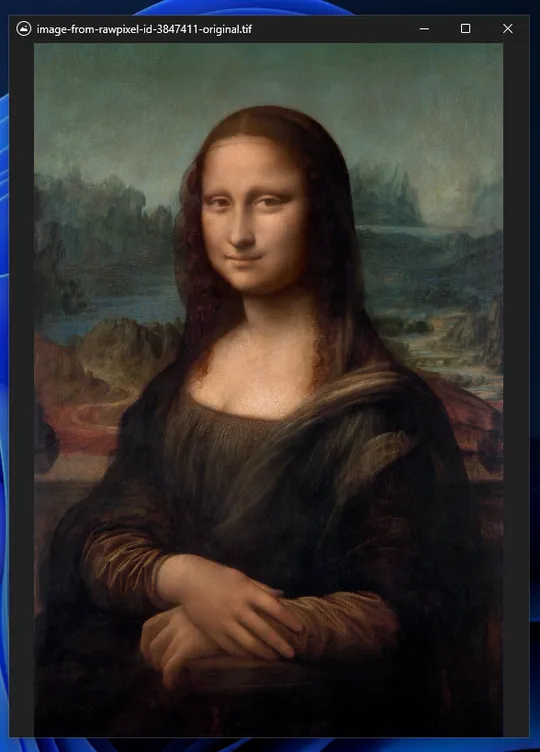
qView doesn't try to be an organizer or editor. It's a pure viewer that supports modern formats and allows for flexible window customization. For example, you can set it to automatically adjust to the size of each new frame.
Advantages
- Absolute minimalism. Zero UI allows you to focus entirely on the aesthetics of your photo.
- Extreme speed. Thanks to the absence of heavy graphic elements, the program consumes negligible resources and opens files instantly.
- Cross-platform. One of the best options for Linux and macOS users looking for a simple alternative to system solutions.
- Full keyboard control. Experienced users can control zoom, rotation, and navigation without using the mouse.
- Open Source. A completely free, open-source project with no ads or tracking.
Disadvantages
- The learning curve is high. A newbie might get confused without the familiar "Forward" or "Back" buttons. You'll have to learn a couple of hotkeys.
- Lack of editing tools. Even basic cropping is unavailable—viewing only.
Conclusion
Choosing a photo viewer depends less on the "best ranking" and more on the user's needs. Some users need to quickly open an image and scroll through a folder of photos, others need to neatly organize a long-standing photo archive, and still others want to jump straight into editing and processing photos. Therefore, there is no one-size-fits-all solution: each program excels in its own niche.
It's good that there are dozens of high-quality tools on the market today, from minimalist viewers to complex cataloging systems and professional RAW converters. Everyone can find an app for virtually any scenario: home archiving, professional photography, cloud computing, or simply quick image browsing.